

15 min readOleksii Buhaiov
Is Vanta or Drata Worth It in 2026? What Compliance Automation Costs and What It Saves
What Vanta, Drata, Secureframe and other compliance platforms cost when most vendors won't print a price, what buyers actually pay, how much time they save depending on who is measuring, when the subscription pays for itself, and when a startup is better off without one.
- soc2
- compliance-automation
- grc
- pricing
- cost
On this page
Vanta's pricing page doesn't show a price. It shows a return. It quotes an IDC study that "found Vanta customers see a 3-month payback period and a 526% return on investment over three years."
The study is public. Vanta paid for it, IDC interviewed eight customers, and those companies averaged 763 employees. One of its tables holds two numbers worth reading side by side. Staff time per audit fell 82%, from 350.8 hours to 61.8. The yearly cost of their frameworks and audits fell 11%, from $97,017 to $86,060.
Both numbers are right. The same companies went from 1.7 audits a year to 4.0. Each audit got much cheaper, and they ran more of them.
That is the question this article answers for a smaller company. A compliance platform makes each audit cheaper. Whether it makes your compliance cheaper depends on how many audits you run and on whether anyone owns the tool.
Where these numbers come from
We collected 20 sources for this article in November 2026 and used several more from our earlier research on compliance costs. They fall into four groups: the vendors' own pricing pages; three spend-management companies that publish what their customers paid (Vendr, SpendHound, Cledara); two ROI studies the vendors paid analyst firms to write; and consultancies and audit firms that don't sell a platform but do sell readiness, implementation or audit work. The procurement sites have a tilt of their own: Vendr sells negotiation, so it gains from the claim that first quotes are inflated. We name the source of every figure. Full list at the end.
The honest headline answer
Of the five platforms whose pricing pages we could read, only one prints a price. Across all company sizes, buyers report a median of $15,000–$28,464 a year, depending on the platform. A small startup on one framework sits at $7,000–$14,000, per two independent sources. The audit is extra.
On 4 November 2026, only Secureframe showed a figure on its own page: from $7,500 a year for one framework. Vanta offers "personalized pricing" on a demo call. Comp AI, which advertised SOC 2 from $8,000 last December, now says it doesn't "hide a rate card" and presents the number on a 20-minute call. Scrut quotes. Thoropass has no pricing page at all. Drata's and Sprinto's pages blocked our attempt to save them, so we can't tell you what they show. Comp AI also publishes a free, self-hosted Community Edition under an open-source licence.
So the useful prices come from the buyer side:
| Platform | On the vendor's own page | What buyers paid, per year | How many contracts behind it |
|---|---|---|---|
| Vanta | no price | $20,000 median (Vendr); $10,880 average (Cledara) | 377 purchases (Vendr); not stated (Cledara) |
| Drata | page blocked | $24,934 median (Vendr); $22,942 average, 50–1,000 staff (SpendHound) | 236 purchases; 160 customers |
| Secureframe | from $7,500 | $20,000 median (Vendr) | not stated |
| Thoropass | no pricing page | $28,464 median (Vendr) | not stated |
| Sprinto | page blocked | $15,000 median (Vendr) | not stated; a narrow, thin range |
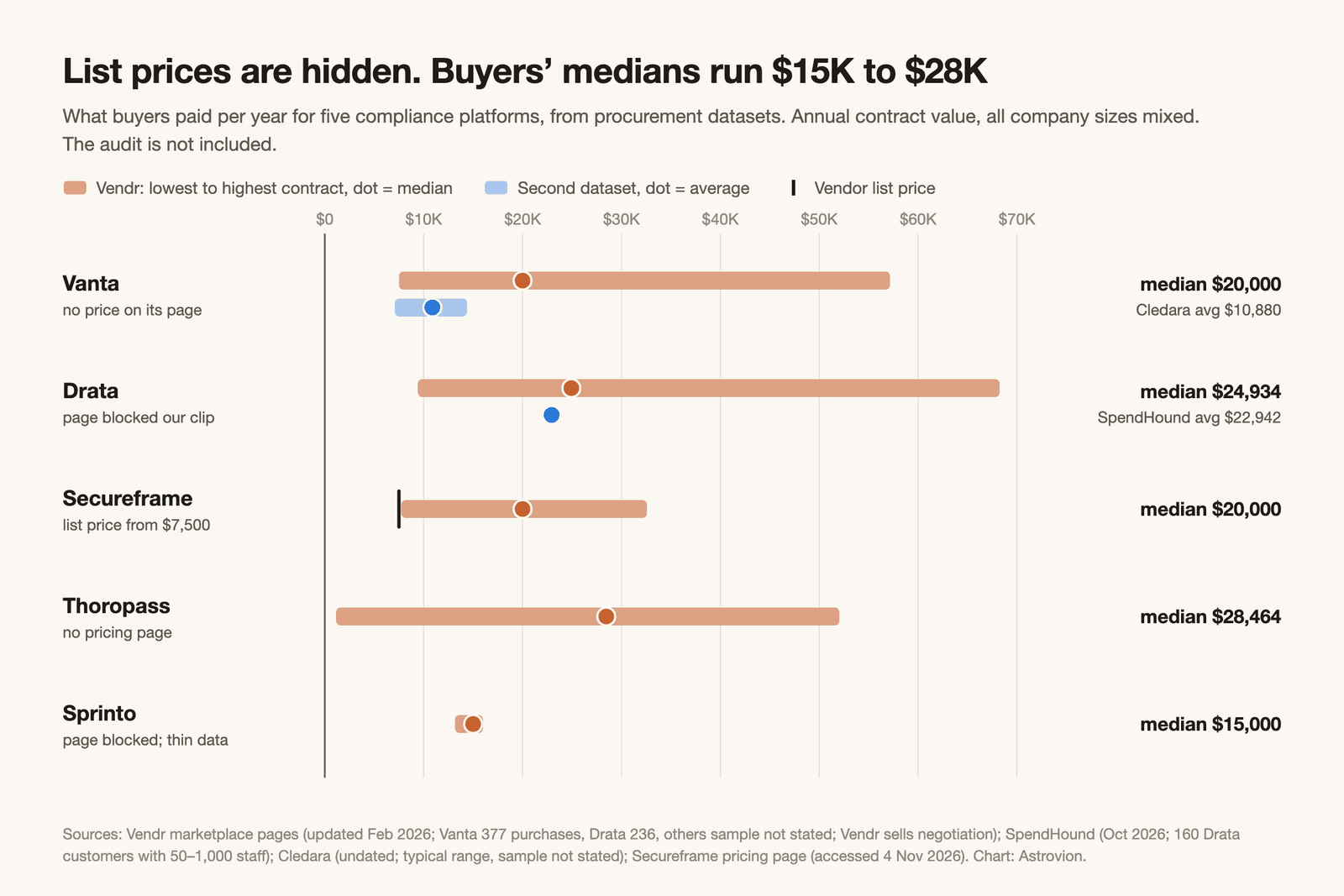
Drata's number is the sturdiest in the category: two procurement companies with separate customer bases land within $2,000 of each other (one reports a median, the other an average). Vanta's is contested.
Two datasets, two Vanta prices
Vendr reports a $20,000 median from 377 purchases. Cledara, a UK spend-management company, reports a $10,880 average with a typical range of $7,078–$14,391, and gives no sample size or date. Cledara's range almost exactly matches what Atlant Security, a SOC 2 readiness firm, saw across its own engagements: $7,000–$14,000 in year one for a 20-person startup. The likeliest explanation is buyer size; neither dataset publishes its mix. We show both and don't average them.
None of the medians is split by company size, so read them as "what a typical buyer pays", not "what a ten-person startup pays". Vendr's pages do offer size bands, but they carry no sample size and disagree with each other from one vendor page to the next. An implementer that sets up both Vanta and Drata, BD Emerson, puts it more simply: under 100 employees on one framework, both "typically quote in the low five figures per year."
What it saves depends on who's measuring
Every source agrees that a platform saves time on evidence: the screenshots, exports and access lists an auditor asks for. They disagree on how much, and the disagreement follows a pattern. The closer the source is to the seller, the bigger the saving.
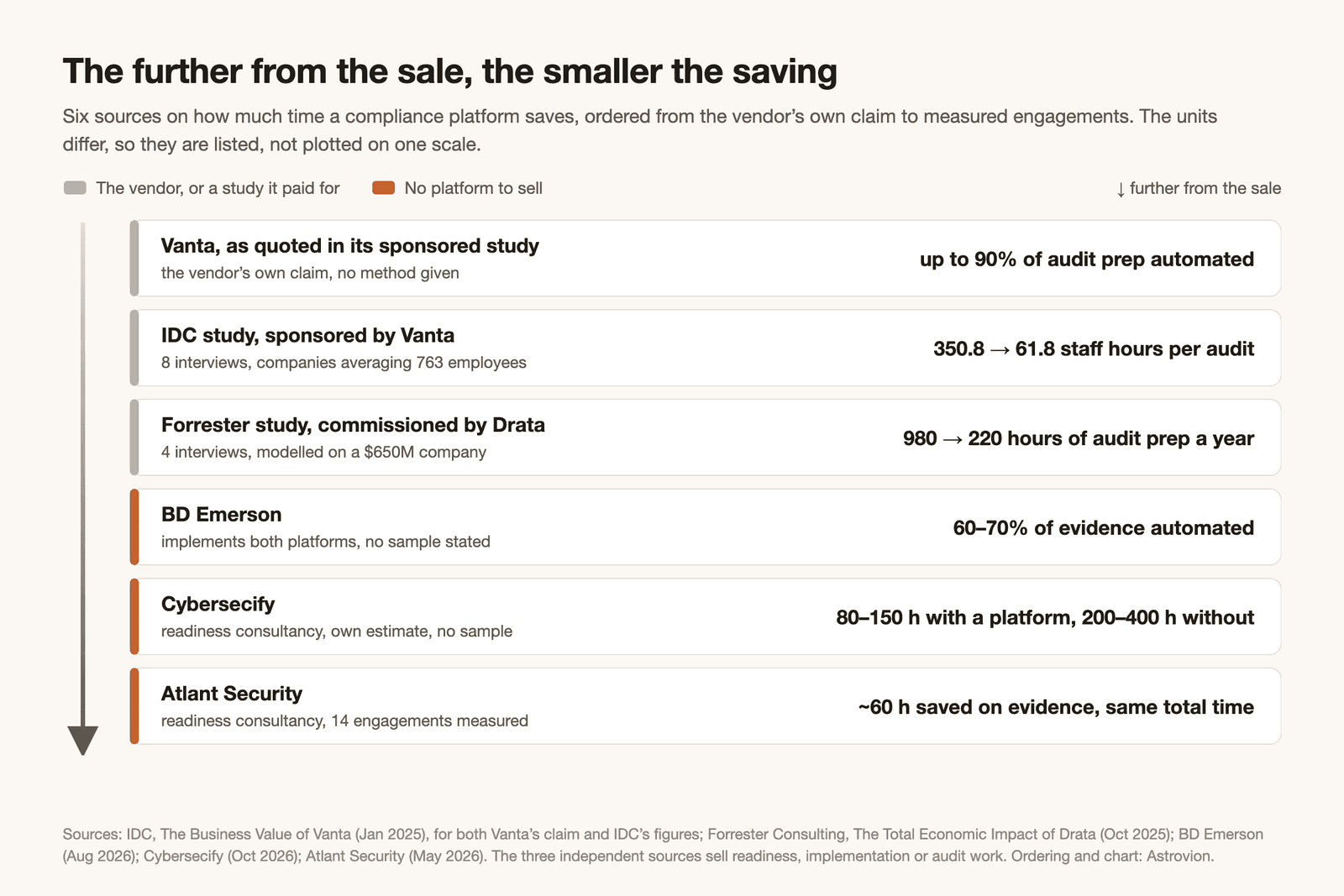
The vendor end of the scale is Vanta's claim, repeated in the IDC study it sponsored, that it "automates up to 90%" of audit preparation. Sprinto's and Drata's own guides say automation cuts costs by 30–50%, and an audit-firm directory says prep time falls "up to 80%". None of the three cites a method.
The two ROI studies have methods, and the vendor paid for each. Forrester's study for Drata interviewed four customers whose names Drata supplied, then modelled a composite company with $650 million in revenue and 1,300 employees. In that model, audit preparation drops from 980 hours a year to 220. Its two largest benefits are not hours at all: extra revenue, and consultants the company no longer hires for new frameworks. The version we read lists $930,000 of benefits over three years and no cost line. IDC's study for Vanta is the one quoted above: eight interviews, companies with a median of 310 staff and an average of 763.
Further from the sale, the numbers shrink:
- BD Emerson, which implements both platforms, says Vanta and Drata "automate the same 60 to 70 percent of evidence" and leave the same remainder: systems with no API, custom internal apps, and anything that needs a person's judgement. (single source: BD Emerson, Aug 2026, practitioner judgement, no sample)
- Cybersecify, a Bengaluru readiness consultancy that says it takes no platform commissions, estimates 80–150 internal hours with a platform against 200–400 without, for a first SOC 2 Type 1 at a Series A startup. (single source: Cybersecify, Oct 2026, its own estimate from engagements, no sample size; its prose elsewhere says 100–200 hours saved, which doesn't match the table)
- Atlant Security measured fourteen of its own SOC 2 Type 1 engagements. Companies with a platform spent about 60 fewer hours on evidence collection and the same total internal time once readiness work was counted.
Does a platform cut your team's total hours?
Cybersecify says yes, by more than half. Atlant says no: the tool saves evidence work and the time goes elsewhere. Both sell readiness consulting; only Atlant reports a sample, and it is fourteen engagements from its own client book. We can't settle it from published data. Atlant's line on what happens without readiness work is the useful warning either way: companies "spend the same total but move money from consulting to tooling."
Does it pay for itself?
For one first audit, the arithmetic is short. Atlant valued internal engineering time at $110 an hour when it priced its engagements. That is a rate Atlant chose, not a market benchmark, but it lets us put the hour counts above into dollars (our arithmetic):
| Hours a platform saves | Whose figure | Worth at $110/hour | Against a startup-tier price of $7,000–$14,000 |
|---|---|---|---|
| ~60 | Atlant, measured, 14 engagements | $6,600 | below even Secureframe's $7,500 floor |
| 100–200 | Cybersecify, prose | $11,000–$22,000 | covers it |
| 120–250 | Cybersecify, table (200–400 minus 80–150) | $13,200–$27,500 | covers it, up to the all-buyer median |
On hours alone, for a single Type 1, the platform pays for itself only if you believe the larger estimate.
Three things change the answer, and IDC's own table shows the first one at work:
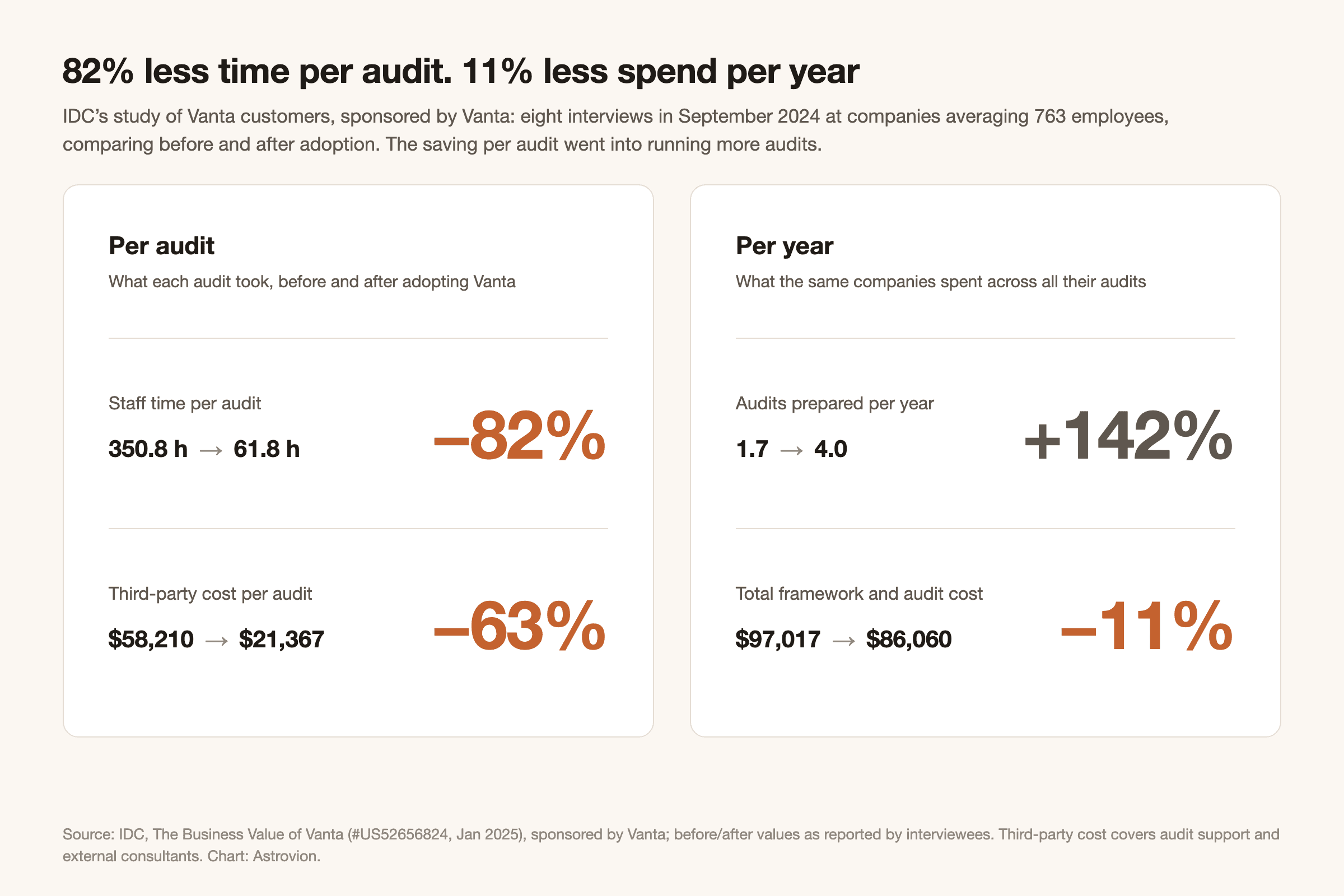
- More audits. The companies IDC interviewed ran 2.4 times as many audits after adopting Vanta, which is how an 82% cut per audit became an 11% cut per year. If you will hold SOC 2, ISO 27001 and HIPAA at once, the per-audit saving repeats. If you hold one report, it happens once a year.
- A Type 2. A Type 2 report covers a window of several months, and the evidence has to be collected throughout it. Continuous collection is what the tools do best, and it is where Cybersecify and BD Emerson both say the purchase starts to make sense.
- Security questionnaires. Forrester's model halves the sales team's time on compliance questions, from 800 to 400 hours a year. That is at a $650 million company. At a startup, the volume is smaller, but the trust-centre and questionnaire modules exist for this reason.
What the subscription leaves out
A platform quote prices the software. The rest of a first SOC 2 sits outside it:
| Outside the subscription | What it costs | Where the figure comes from |
|---|---|---|
| The audit itself | Type 1 auditor fee, median $22,000 | Atlant, 14 engagements. Vanta and Secureframe list access to an auditor network, not an audit; Comp AI can bundle one |
| Setup | $2,000–$10,000 (Vanta), $5,000–$20,000 (Drata) | Vendr, no sample size; Vendr says about 60% of first-time Drata buyers pay for services |
| A second framework | priced as a paid add-on | BD Emerson; Vendr |
| Fixing the gaps | half of Atlant's clients spent under $4,000, half $12,000–$24,000 | Atlant; "no platform does it" (Cybersecify) |
| Someone to run it | 80–150 hours with the tool (Cybersecify estimate) | the tool needs an owner after the audit, too |
| Year two | Drata spend +6.48% a year at companies with 50–1,000 staff | SpendHound, 112 customers; includes added scope |
The setup line matters more than its size. Vendr's estimate that most first-time Drata buyers pay for help is unsourced, but it matches what the implementers sell. BD Emerson advises budgeting configuration "as a separate line", and that is the service it offers. The software is bought in a day. Making the controls inside it describe your company takes weeks.
The trap: a green dashboard and a contract that renews itself
The failure mode in this category is consistent enough to count as corroborated: four sources with nothing in common describe it.
- Atlant watched clients take a dashboard from 30% to 95% green in a week and treat that as readiness; those companies "ran into walls in week 12".
- Cybersecify sees founders buy Vanta because "everyone uses Vanta", never set it up properly, and reach the audit deadline with green dashboards and incomplete evidence.
- Linford & Co, a CPA firm that performs SOC audits, puts it in one line: "Tools can't remediate controls for clients."
- BD Emerson says a tenant without an owner piles up failing tests and stale policies "within a quarter or two", and that an auditor "reads a neglected dashboard as a finding".
The dashboard measures whether automated configuration checks pass. It does not measure whether your policies match what the company does, whether access reviews happened, or whether the gaps it found were fixed.
The contract keeps running after the project ends
These are annual contracts. Vendr says most renew automatically, with 30–60 days' notice, and can't be cancelled mid-term. The one measured renewal figure, from SpendHound's data on 160 Drata customers, is spend up 6.48% a year for companies with 50–1,000 staff and 17.84% for enterprises; that includes customers who added frameworks or staff, so it overstates pure price rises. Vendr's claim for Vanta is higher, renewal quotes "often" up 10–20% unless renegotiated, with no sample size behind it. Thoropass is the exception: Vendr says its single-framework renewals often come in 20–40% below the first year's implementation pricing.
One Hacker News commenter describes the worst case: a startup that told Vanta it would not renew, had not logged in for ten months, and was chased to collections for another $10,000 year (single source: one Hacker News comment, March 2026; unverified). It is one account. The contract terms that make it possible are the ones Vendr describes as standard.
Bottom line
The median buyer pays $20,000–$25,000 a year for Vanta, Drata or Secureframe, and a small startup $7,000–$14,000, plus the audit. It reliably saves evidence work. It saves total cost when you run several frameworks or a Type 2, and when someone owns it.
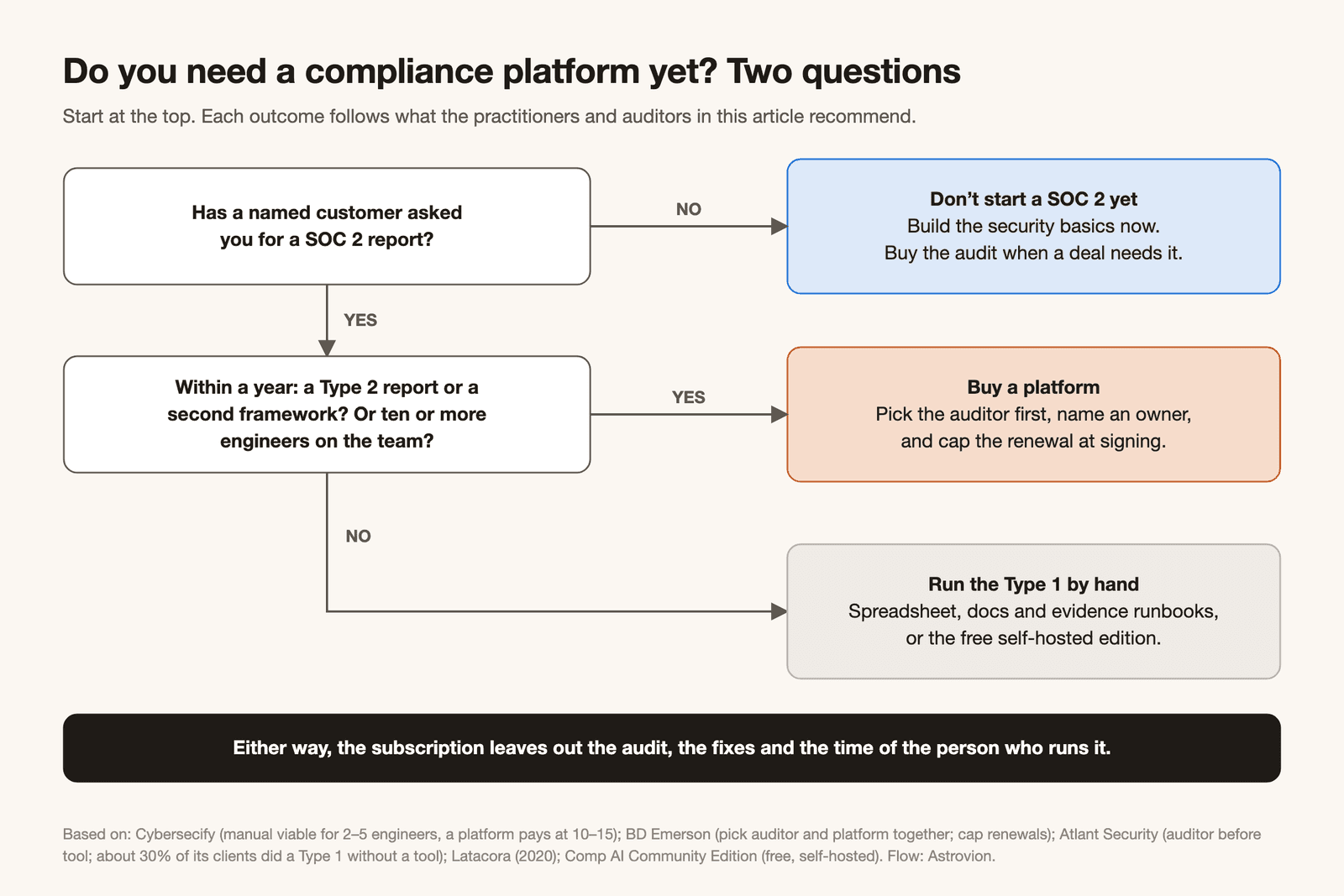
Three things to do before you sign:
-
Decide by how many audits you'll run, not by the demo. A first, one-time Type 1 with two to five engineers can run on spreadsheets and evidence runbooks: Cybersecify says so, and Atlant says about 30% of its clients have done it (though only one of the fourteen engagements it detailed ran without a tool). Latacora's 2020 guide made the same point: what auditors ask for can be tracked in a spreadsheet and a git history. Once a Type 2 window or a second framework is coming, buy.
-
Choose the auditor first, then the tool, and name the person who owns it. Atlant reports that choosing in the wrong order "causes rework in week 8"; BD Emerson says to pick them together, because some audit firms work more natively in one platform. Then give the tool an owner with time in their calendar after the audit, not only before it.
-
Negotiate the renewal while you still have leverage. Ask for a cap on annual increases in the first contract, put the notice date in the calendar, and get a second quote. Vendr says prepared buyers pay 20–40% less than first quotes; it sells that negotiation, so treat the size as its claim, but the direction is consistent with every renewal source we read.
Weighing a platform against doing it by hand? We start with a paid compliance scoping sprint: you walk away with the frameworks your actual buyers require, a two-year audit forecast, a platform-or-manual recommendation with the break-even worked out at your own team's rates, and a contract checklist covering setup, add-ons and renewal terms. It's yours to keep, whoever does the work. Request a consultation →
Sources
Buyer-side price data:
- Vendr — pricing pages for Vanta, Drata, Secureframe, Thoropass and Sprinto (updated Feb 2026)
- SpendHound — Drata Pricing (updated Oct 2026)
- Cledara — Vanta Buyer's Guide (undated)
Vendor pages (accessed 4 November 2026):
Vendor-commissioned studies:
- Megan Szurley, Grace Trinidad and Philip D. Harris, IDC — The Business Value of Vanta, sponsored by Vanta (Jan 2025)
- Forrester Consulting — The Total Economic Impact of Drata, commissioned by Drata (Oct 2025)
Practitioners and auditors:
- Alexander Sverdlov, Atlant Security — SOC 2 Type 1 in 2026: What 14 Real Engagements Cost (May 2026)
- Ashok Kamat, Cybersecify — Vanta vs Drata vs Secureframe vs Sprinto 2026 (updated Oct 2026)
- Leslie Sakal, BD Emerson — Vanta vs Drata: An Implementer's Comparison (Aug 2026)
- Rob Pierce, Linford & Co — AICPA FAQs on SOC 2 Automation Tools (Jun 2022)
- Latacora — The SOC2 Starting Seven (Mar 2020)
- Peter Korpak, SOC2Auditors — SOC 2 Type 2 Audit Cost (May 2026); Srividhya Karthik, Sprinto — SOC 2 Compliance Cost (Dec 2025); Drata — How Much Does a SOC 2 Audit Cost? (Mar 2026); Comp AI — Why Get SOC 2 Before Series A (Dec 2025) — sources of the unsourced savings claims and the earlier $8,000 price
- Hacker News — discussion of Delve (Mar 2026) — the auto-renewal account
All figures are quoted from these publications for commentary and analysis; the tables, comparisons, worked examples and conclusions in this article are our own. Every image and chart was made for this article.