

17 min readOleksii Buhaiov
Fixed Price vs Time and Materials in 2026: Which Software Contract Actually Protects the Buyer
What fixed-price and time-and-materials software contracts actually protect you from, who pays the overrun under each according to the one study that measured it, why the "15–30% risk premium" every guide quotes has no source, what a T&M ceiling is worth, and three clauses to put in either contract.
- software-contracts
- fixed-price
- time-and-materials
- outsourcing
- development-cost
On this page

In November 2007, De Beers signed a fixed-price contract with Atos Origin to rebuild the systems behind its diamond-sorting business, which it planned to move from South Africa to Botswana. It had even paid for a separate analysis phase first, so Atos could price the job properly. Seven months later Atos stopped work, asked to finish the project at cost, roughly £2.9 million with no profit, and never came back. De Beers sued and won. The English High Court found that Atos had walked away from the contract and awarded De Beers £1.41 million net. De Beers never got the system. Afterwards it only patched its old ones.
In 2019, Hertz sued Accenture for more than $32 million over a website and app rebuild whose launch slipped from December 2017 to April 2018, before Hertz removed Accenture and, by its own account, paid another firm $10 million to fix or replace the work. Accenture's answer to the claim that it had demanded more money than agreed was one line: "This was not a fixed price contract and instead, Accenture was paid on a time and materials basis."
Two buyers lost money and years under opposite contracts. A contract type doesn't remove risk. It decides which risk you carry. The real question is whether you can carry it.
Where these numbers come from
We built this article from 28 published sources: one peer-reviewed study of who actually pays software overruns, four other research papers, the US federal procurement rules and a federal audit of how they work in practice, three US government digital-service guides, agile-contract practitioners, two law-firm analyses, coverage of two lawsuits, and seven guides from development agencies and a freelance marketplace. The agency guides recommend whatever their authors sell, so we name the publisher every time a number appears. Full list at the end.
The honest headline answer
A fixed price protects your budget, but only as well as your specification does. It moves most of the overrun to the vendor, not all of it. Time and materials (T&M, paying for hours actually worked) protects your ability to change course and to stop. In return you carry the overrun and the work of watching the hours.
The most useful rule we found isn't from a vendor at all. It's in the US Federal Acquisition Regulation (FAR), the rulebook for federal contracts. It allows T&M "only when it is not possible at the time of placing the contract to estimate accurately the extent or duration of the work." It requires every T&M contract to carry a ceiling price "that the contractor exceeds at its own risk." And it tells buyers to "avoid protracted use" of T&M once experience gives a basis for firmer pricing.
Put plainly: pay for time while you're still finding out what to build, and fix the price once you can write down what "done" means. The rest of this article is about why that order matters and what to write into the contract either way.
What each contract actually protects you from
This is the comparison the agency guides don't publish. The rows are the risks a buyer actually faces. The cells say what each contract does about them, according to the sources. The grouping is ours.
| Risk to the buyer | Fixed price | Time and materials | T&M with a ceiling and sprint-by-sprint exit |
|---|---|---|---|
| The build costs more than planned | Vendor carries most of it. In the one study that measured it, 63% on average | You carry most of it. Vendor carries 15.5% on average | Capped, as long as you don't raise the ceiling |
| You need to change what's built | Each change is a priced change request | Changes are a backlog decision | Same as T&M |
| The work is poor | Payment can be tied to acceptance, if acceptance is defined | You pay for hours, good or bad | You inspect working software each sprint and can stop |
| You want to stop early | Termination terms, often costly | Stop assigning work | Stop at the end of any sprint |
| Your own management time | Lowest | Highest: you watch the hours | High |
| The price you pay for that protection | A risk premium nobody can measure (next section) | Your oversight, and the overrun | Your oversight |
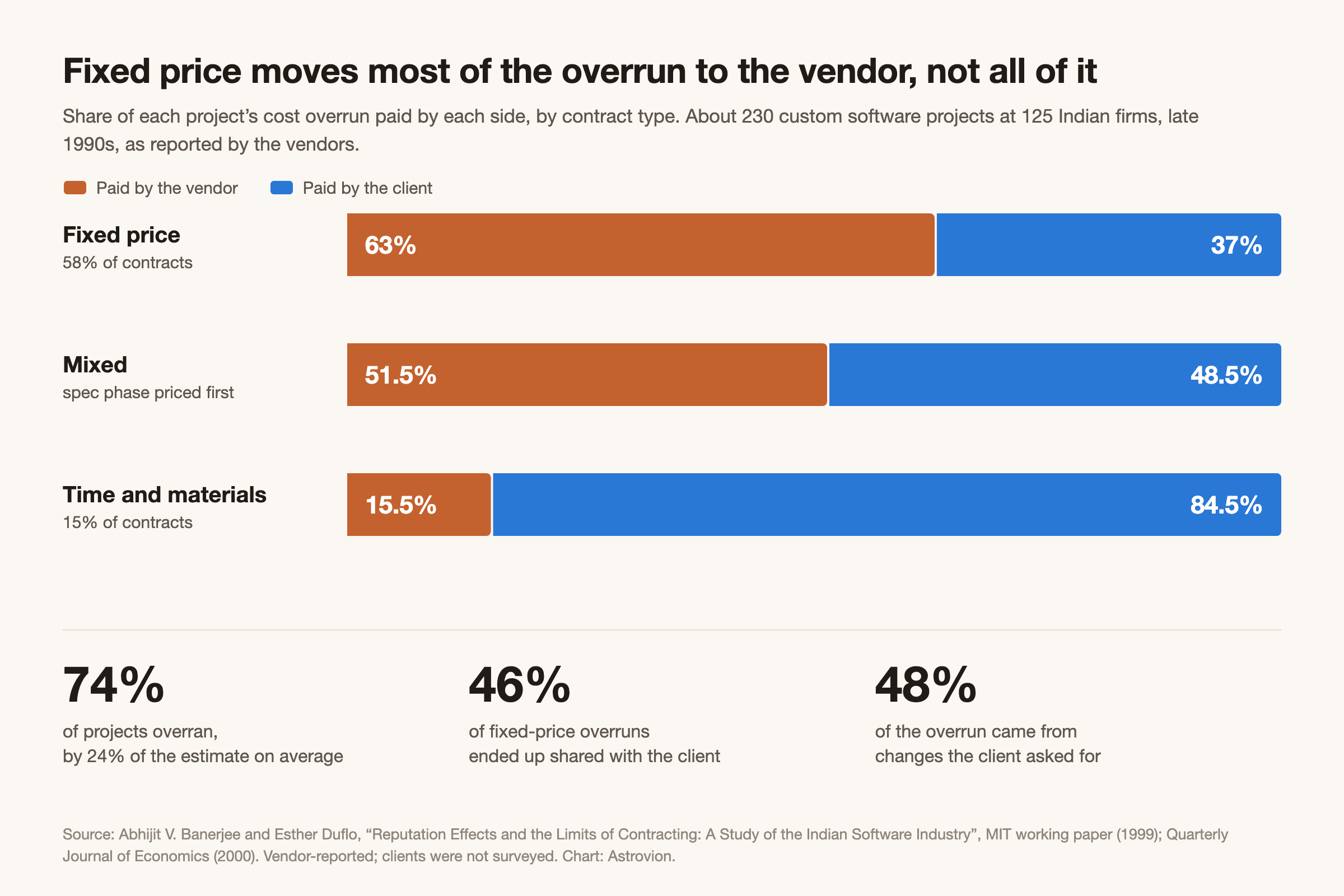
The first row comes from the only dataset we found that measures who actually pays when a software project overruns. In a study published in the Quarterly Journal of Economics in 2000, the economists Abhijit Banerjee and Esther Duflo interviewed the heads of 125 Indian software firms about roughly 230 recent projects.
What they found:
- Overruns were the norm, not the exception. 74% of projects overran, by 24% of the initial estimate on average. Fewer than 5% came in under.
- Fixed price moved most of the overrun to the vendor, not all of it. On fixed-price contracts vendors bore 63% of the overrun on average. On T&M they bore 15.5%.
- Fixed prices got reopened. On 46% of fixed-price projects, the overrun ended up shared between client and vendor.
- The buyer caused the biggest share. Changes the client asked for caused 48% of the overrun on average, unclear specifications another 20%. The firms' own internal problems caused 8%.
- Nobody went to court. Not one project in the sample ended in arbitration. The two sides renegotiated instead.
Two caveats matter. The data covers one country and is a quarter of a century old. And only the vendors were asked; the clients weren't. Use the shape, not the exact levels. That shape is consistent with what every other source in this article describes: a fixed price moves the risk without removing it. The Australian law firm Hall & Wilcox put it almost word for word in 2026: fixed-price technology contracts "shift risk - they don't remove it."
The risk premium: a number nobody can source
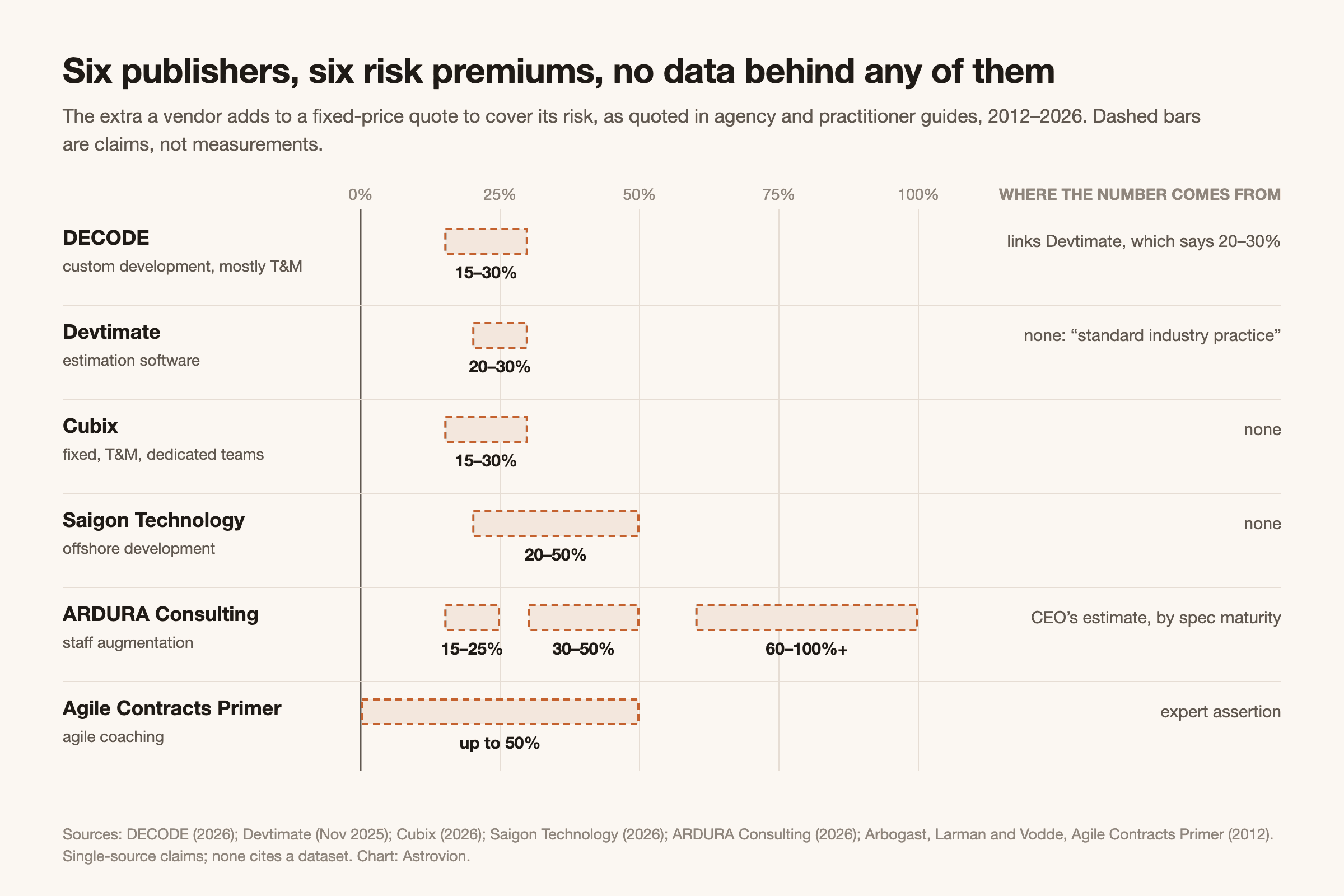
Every guide we read says a fixed price costs more because the vendor adds a buffer for risk. That part is uncontroversial. The size of the buffer is another matter.
| Publisher | What it sells | Premium it quotes | Where the number comes from |
|---|---|---|---|
| DECODE (Croatia, Germany) | Custom development, mostly T&M | 15–30% | Links a Devtimate blog post, which says something else |
| Devtimate | Estimation software for agencies | 20–30%, "+30%" | Nothing: "Standard industry practice for unknowns" |
| Cubix | Fixed, T&M and dedicated teams | 15–30% | Nothing |
| Saigon Technology (Vietnam) | Offshore development | 20–50% | Nothing |
| ARDURA Consulting (Poland) | Staff augmentation and development | 15–25%, 30–50% or 60–100%+, by how well the scope is specified | The CEO's own estimate |
| Agile Contracts Primer (Arbogast, Larman, Vodde) | Agile coaching | "as high as 50%" | Expert assertion |
Single source — unverified
The "15–30% risk premium" appears in identical form on at least two agency sites. The only trail we could follow ends at one blog post by Devtimate, a vendor of estimation software (November 2025). That post gives a different range, 20–30%, and cites nothing. The same post sells its tool as a way to calculate the buffer "rather than throwing a random '30%' on top." None of the six sources above measures a premium. What would settle it: paired fixed-price and T&M bids for the same specified scope. We found none. Treat every percentage here as a vendor's claim, not a benchmark.
The one structural point worth keeping comes from ARDURA's CEO, Bartosz Ciepierski. The premium depends on how much of the work is pinned down when you ask for the price. A well-specified build carries a small buffer. A scope described as business outcomes carries a large one, or the vendor declines to fix a price at all. His numbers are unsourced. The direction matches the FAR rule above and Banerjee and Duflo's finding that unclear specifications cause a fifth of overruns.
In practice the premium isn't something you negotiate down. You reduce it by specifying the work before you ask for a fixed price.
What moves the risk, and what T&M really costs
Four things decide whether a contract leaves you exposed. The pricing model isn't one of them.
| Driver | Raises your exposure | Lowers it | Evidence |
|---|---|---|---|
| How well the work is specified | Scope described as goals or outcomes | Acceptance criteria per deliverable | FAR 16.202 and 16.601; ARDURA (unsourced estimate) |
| How much you change your mind | Changes after signing | Changes made inside a fixed budget, by swapping items | Banerjee and Duflo: client changes cause 48% of overrun |
| The vendor's track record with you | A new vendor, a first project | A repeat relationship | Banerjee and Duflo: firms with repeat clients paid 20% less of the overrun; young firms were 26% more likely to sign fixed price |
| Your capacity to oversee | Nobody on your side reviewing invoices and working software | A named owner who checks every sprint | GAO-07-273; 18F |
The last row is the hidden cost of T&M, and the regulator is blunt about it. A T&M contract, the FAR says, "provides no positive profit incentive to the contractor for cost control or labor efficiency," so the buyer has to supervise. The US Government Accountability Office (GAO) audited how the Defense Department used T&M contracts in 2007. Its conclusion: "the onus is on the government to prevent wasteful spending." Even with supervision, buyers "may not reduce payments for hours actually worked" when they think the work was done inefficiently.
GAO also found what happens when nobody holds the line. Most of the contracts it sampled had no documented monitoring plan. On one $17 million Army contract, the people assigned to oversee it didn't review the invoices. And the ceilings moved.
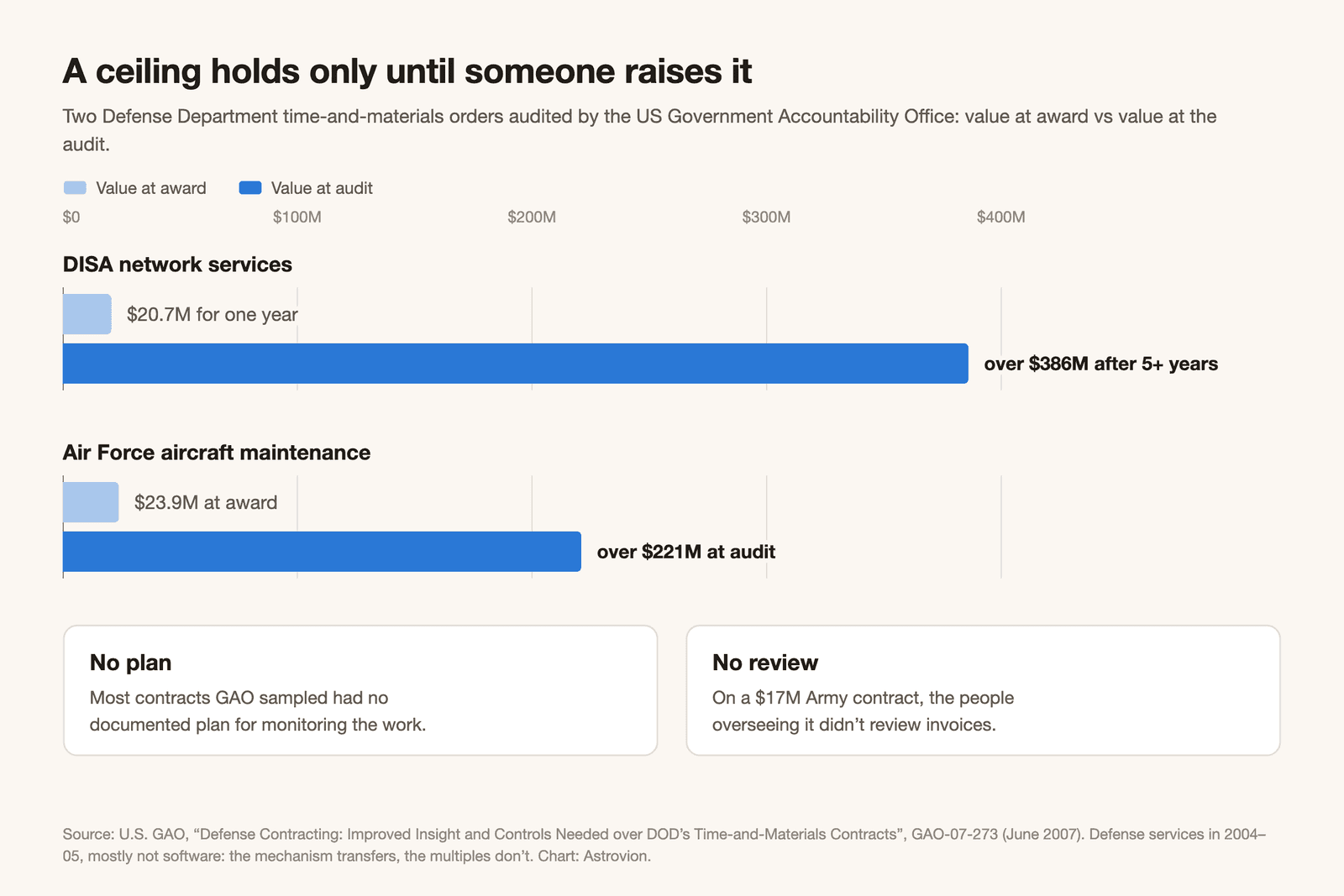
A ceiling caps your spend only for as long as you refuse to raise it. The FAR lets the buyer raise it after a documented price analysis, and in these two cases that's what happened, again and again. These were Defense services from 2004–05, mostly not software, so don't carry the multiples over to your project. Do carry the mechanism: a ceiling you raise every time it's reached is just T&M with extra paperwork.
The case for T&M comes from the same government. 18F, the digital-services team inside the US General Services Administration until it closed in 2025, told agencies to buy custom software on T&M "with a not-to-exceed ceiling," rather than a firm fixed price. Its argument: you can stop at any point "without having to go through the burdensome termination procedures" and still own what was built. It also admitted the cost: agile contract administration "requires more time and effort on the part of the government."
Contradiction
18F says that for software, a T&M contract "protects the government's financial and performance interests better than other contract types." The FAR and the GAO audit treat T&M as the highest-risk contract type for the buyer. 18F's answer is an active owner on the buyer's side who inspects working software every sprint. Neither side offers outcome data, so this one stays open. The 2026 rewrite of the FAR leans the other way: it makes fixed price the "default and preferred" contract type.
The trap: the fixed price that reopens and the change request that pays the bills
The usual failure isn't picking the wrong model. It's believing the model did the protecting.
With a fixed price, the trap is the gap between what you wrote down and what you meant. Hall & Wilcox say disputes over fixed-price technology contracts "almost always turn on whether particular work falls inside or outside the agreed scope." They call user experience "the deliverable everyone expects, but no one defines." Every gap becomes a change request, and the vendor prices it with no competition. Martin Fowler, chief scientist at Thoughtworks, described vendors who "deliberately low-bid the fixed price, with the explicit plan of making a profit on change requests." The Agile Contracts Primer notes that in India this change-request income is called "rent."
De Beers shows the other half of the trap. It won in court because Atos had agreed to "a fixed fee for fixed scope." But the lawyers who analysed the judgment point out that De Beers had never described many of its own operations during the tender. The fixed price held, and it didn't produce a system. The same authors call "a fixed fee and an inadequately defined scope" a "toxic combination."
With T&M, the trap is a fixed-looking number in a contract that isn't fixed. Hertz's phase-two statement of work listed fees of $26 million. Accenture's position was that this was time and materials all along. Coverage of the case doesn't make clear whether the $26 million was an estimate or a commitment, and that ambiguity is the point. If you can't tell from your own contract whether a number is a price or a forecast, it's a forecast.
What protects you isn't on the price line
In every case above, the buyer's protection depended on three things that work the same under either contract: a written test of when each deliverable is done, a price for changes agreed before signing, and the right to stop. A freelance marketplace shows the difference in miniature. On Upwork, fixed-price money sits in escrow until you approve the work, with 14 days to review. On an hourly contract you can dispute hours, but, in Upwork's words, "you cannot file a dispute because you are not satisfied with the quality."
Bottom line
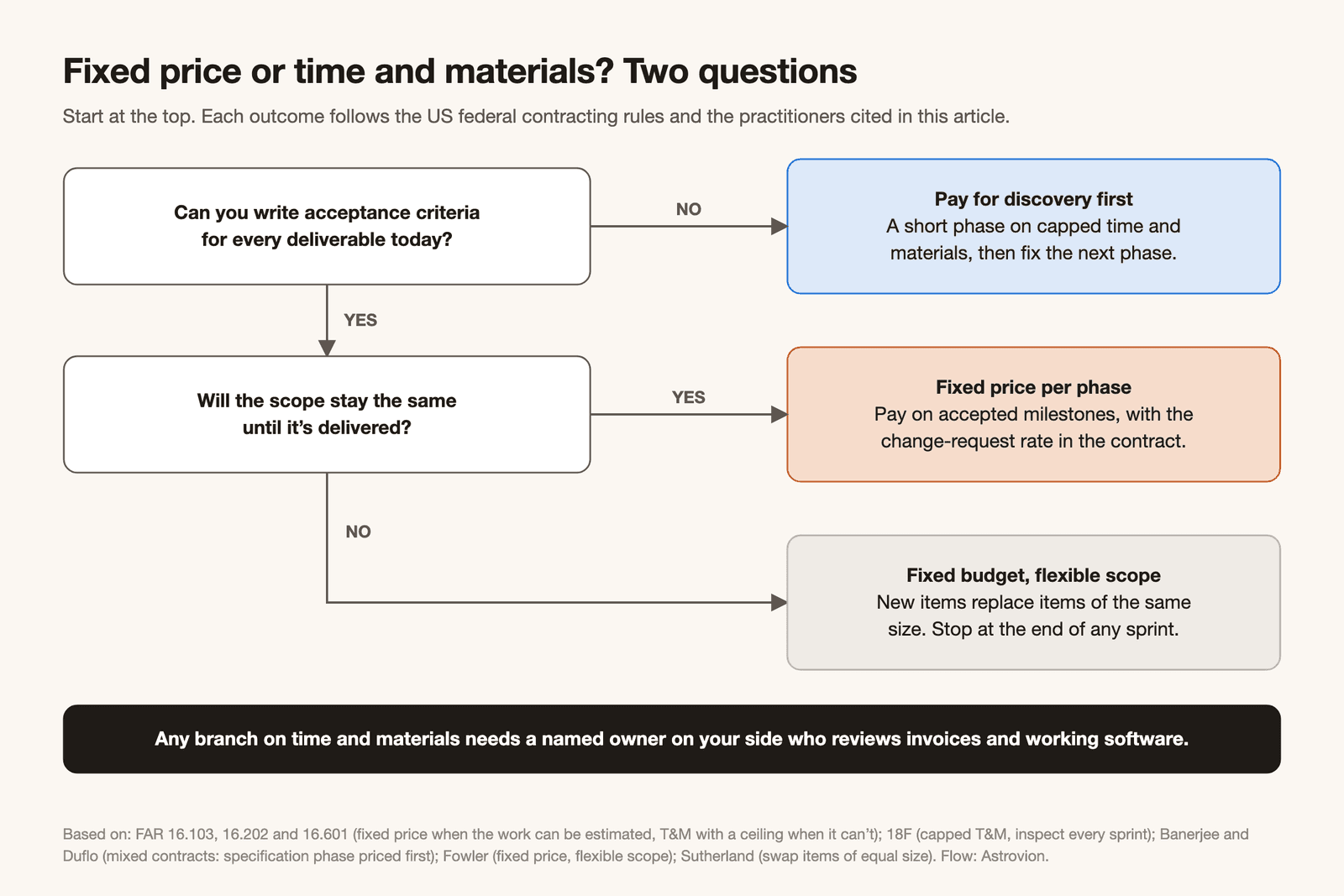
Fixed price protects your budget only as well as your specification does. T&M protects your options only if someone on your side watches the hours. Most buyers should use both, in order: time-based while you work out what to build, fixed per phase once you can define done.
Three clauses to get into the contract, whichever model you sign:
-
Acceptance criteria for every paid deliverable. Write down what "done" means, including the screens, devices and edge cases people assume. Without it, a fixed price becomes a string of change requests, and T&M becomes paying for hours with nothing to check them against. If you can't write the criteria yet, that's your signal to pay for discovery on time and materials first.
-
The change-request rate, fixed before you sign. Agree the day rate and approval process for changes now, while you still have competition. Better still, agree that new items replace items of the same size inside the budget instead of being added on top.
-
A ceiling you won't raise, and an exit at every milestone. On T&M, a not-to-exceed ceiling with a weekly burn report, and the right to stop at the end of any sprint and keep what's built. On fixed price, payment against accepted milestones, not dates. In both, name the person on your side who reviews invoices and working software.
The contract that protects you is the one whose risk you've chosen to carry, written down so that both sides can check it.
Not sure your scope is ready for a fixed price? We start with a paid scoping sprint: you walk away with acceptance criteria for each deliverable, a recommendation on which parts can be fixed-price and which should stay on capped time and materials, and the change-rate and exit terms to put in the contract. It's yours to keep, whoever ends up building the product. Request a consultation →

Sources
Research:
- Abhijit V. Banerjee, Esther Duflo — Reputation Effects and the Limits of Contracting: A Study of the Indian Software Industry, MIT working paper (1999); Quarterly Journal of Economics 115(3) (2000)
- Anandasivam Gopal, Konduru Sivaramakrishnan, M. S. Krishnan, Tridas Mukhopadhyay — Contracts in Offshore Software Development: An Empirical Analysis, Management Science (2003)
- Bent Flyvbjerg, Alexander Budzier, Jong Seok Lee, Mark Keil, Daniel Lunn, Dirk W. Bester — The Empirical Reality of IT Project Cost Overruns: Discovering a Power-Law Distribution, Journal of Management Information Systems (2022)
- J. Laurenz Eveleens, Chris Verhoef — The Rise and Fall of the Chaos Report Figures, IEEE Software (2010)
US government:
- FAR Council — FAR Subpart 16.1, Subpart 16.2 and Subpart 16.6 (FAC 2026-01); FAR Overhaul Part 16 (2026)
- U.S. Government Accountability Office — Defense Contracting: Improved Insight and Controls Needed over DOD's Time-and-Materials Contracts, GAO-07-273 (2007)
- 18F, General Services Administration — Buying Custom Software Development Services and the De-risking Federal Field Guide (2023–24)
Practitioners, lawyers and cases:
- Tom Arbogast, Craig Larman, Bas Vodde — Agile Contracts Primer (2012)
- Martin Fowler — FixedPrice (2003) and FixedScopeMirage (2004)
- Wayne Kelcey, Jessica Pascual, Hall & Wilcox — Three gaps in tech contracts revealed by disputes you rarely see in court (2026)
- William B. Bierce, Henry Jones III, Bierce & Kenerson — Failed Software Development: De Beers v Atos Origin (2011)
- John Belden, UpperEdge — Hertz Takes Accenture Out of the Driver's Seat and Accenture Tells Hertz You Should Have Read the Fine Print (2019)
Agency guides and marketplace:
- Marin Luetic, DECODE — Fixed price vs time and materials (2026)
- Tommy Phan, Devtimate — The hidden cost of fixed price contracts (2025)
- Bartosz Ciepierski, ARDURA Consulting — Fixed-price software: who really pays for risk transfer (2026)
- Thanh (Bruce) Pham, Saigon Technology — Fixed Price Software Development: Comparison With Time and Material (2026)
- Kainat Farman, Cubix — Software Development Engagement Models (2026)
- Upwork Help Center — Decide between hourly and fixed-price contract (2026)
All figures are quoted from these publications for commentary and analysis; the tables, comparisons and conclusions in this article are our own. Every image and chart was made for this article.