
1 min readOleksii Buhaiov
How Much Does It Cost to Build a SaaS in 2026? The Build Price and the Bill That Follows
What a SaaS costs to build and to run in 2026 — first-version quotes from seven agency guides side by side, the SaaS-only line items they price differently, running costs at the vendors' own list prices, and what companies that already run a SaaS spend every year after launch.
- saas
- development-cost
- startups
- running-costs
- pricing
On this page

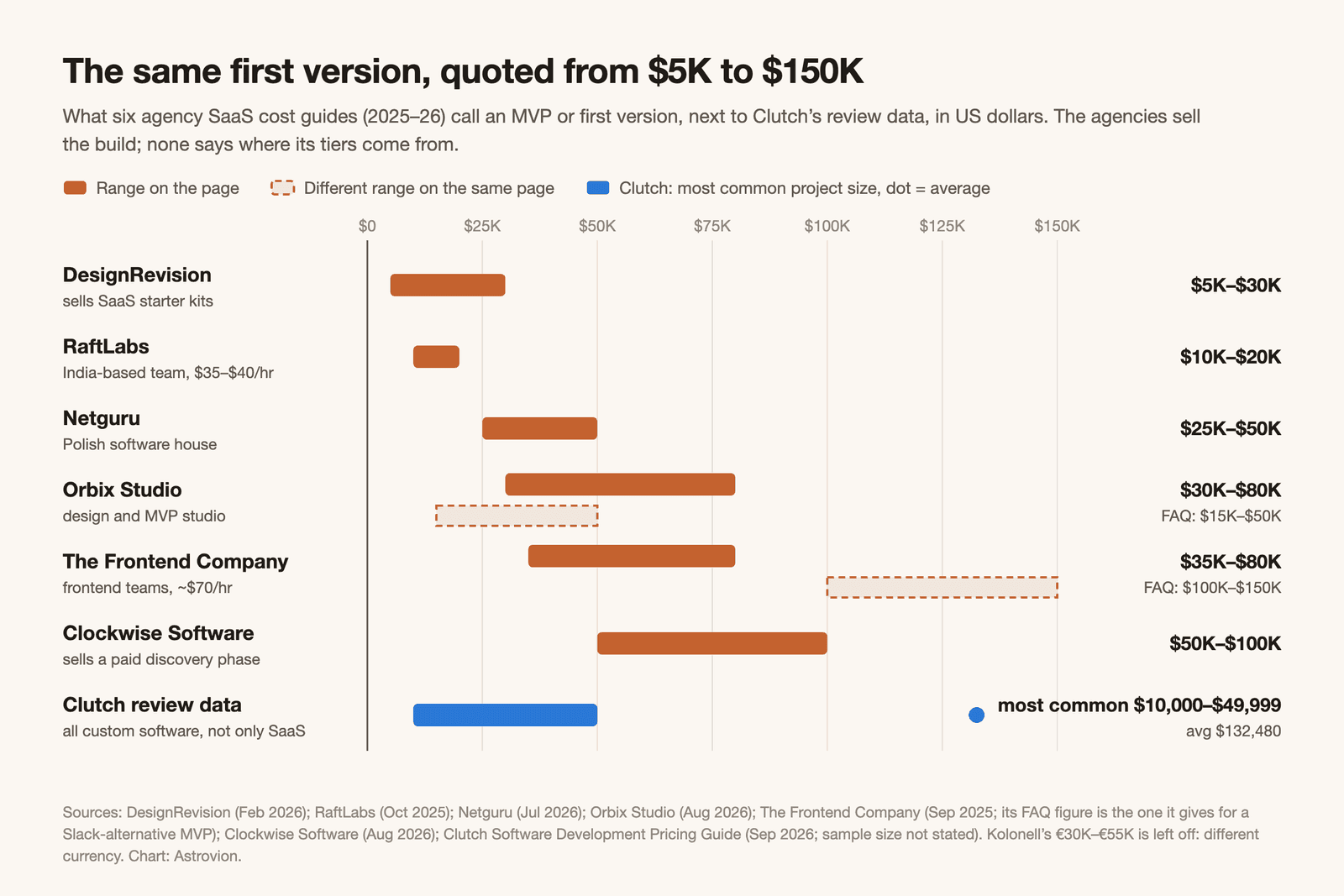
RaftLabs, an Indian development agency, prices a SaaS MVP at $10,000–$20,000. Clockwise Software, a Ukrainian one, starts at $50,000 and says that below it "you're buying a prototype." The Frontend Company's pricing table puts a startup SaaS at $35,000–$80,000; the FAQ on the same page says a lean MVP costs $100,000–$150,000.
Then nearly every guide turns to maintenance and gives a rule of thumb: about 15–25% of the build cost per year. On a $60,000 build, that is $9,000–$15,000 a year.
Companies that already run a SaaS report something else. In SaaS Capital's 2026 survey of more than 1,000 private B2B SaaS companies, the median spends 22% of its annual recurring revenue on R&D, the same share as a year earlier. At $1 million of revenue, that is $220,000 a year, more than any of the quotes above for the whole first version.
The two numbers don't measure the same thing: R&D includes new features, not just upkeep. That is the point. A SaaS quote prices the first version. The product then costs a share of its revenue for as long as it has customers. Budget both, and treat the second as the bigger one.
Where these numbers come from
We built this article from 19 published sources: seven agency cost guides, eight vendor pricing pages read on 20 October 2026, two benchmark surveys of operating SaaS companies, Clutch's review-based pricing page, and an Oxford study of IT project overruns. Every agency guide is written by a company that sells SaaS builds, and none of them says where its price tiers come from. We name the publisher every time a number appears. Full list at the end.
The honest headline answer
Agencies quote a first SaaS version at anywhere from $5,000 to $150,000. Most quotes sit between $25,000 and $100,000. The top of one guide's range is fifteen times the bottom of another's, for what each calls an MVP.
| Seller | What it sells | First version, as quoted | Timeline |
|---|---|---|---|
| DesignRevision | SaaS starter kits | $5K–$30K ("validated MVP") | not stated |
| RaftLabs | India-based development at $35–$40/hr | $10K–$20K | 6–8 weeks |
| Netguru | Polish software house | $25K–$50K ("basic") | not stated |
| Orbix Studio | design and MVP studio | $30K–$80K (its FAQ: $15K–$50K) | 2–4 months |
| The Frontend Company | frontend teams at ~$70/hr | $35K–$80K (its FAQ: $100K–$150K) | 4–8 weeks, simple MVP |
| Clockwise Software | a paid discovery phase, then the build | $50K–$100K | 3–6 months |
| Kolonell | a templated city page, Berlin edition | €30K–€55K | 3–5 months |
Some of the guides contradict themselves. The Frontend Company's $100,000–$150,000 is the figure its article gives for an MVP of a Slack alternative; its FAQ then presents it as the price of a lean MVP in general. Orbix Studio's services table and its FAQ give different MVP ranges.
The pattern follows the business model. The seller with the lowest hourly rate quotes the lowest build. The seller whose offer is a paid discovery phase defines anything under $50,000 as a prototype. Neither is lying; they are pricing different products under one name.
The one number not written by an agency comes from Clutch, the review marketplace for agencies. From reviews by verified clients, it reports an average custom-software project of $132,480 over about 13 months, and the most common project size is $10,000–$49,999. Clutch doesn't state a sample size, the data covers all custom software rather than SaaS, and Clutch's paying customers are the agencies it lists. One of the guides we read, Orbix Studio's, turns Clutch's most common bucket into its "simple MVP" price tier for a SaaS. That bucket is a range of all custom-software projects, not a SaaS price.
What makes it a SaaS: the line items quotes price differently
A SaaS is not an app with a subscription button. Customers from different companies share one system, pay on a schedule that changes, and expect their data kept apart. Those requirements become line items, and that is where the guides diverge most. The grouping below is ours; the prices are each guide's own, none with a stated origin.
| Line item | Lowest quote we found | Highest quote we found | What to pin down in your quote |
|---|---|---|---|
| Login and user management | $800–$2,000 (RaftLabs) | $3,000–$15,000 (Orbix Studio) | SSO, two-factor login, invitations |
| Subscription billing | $2,500–$5,000 (RaftLabs) | $12,000–$25,000 for complex payments (DesignRevision) | trials, upgrades, proration, failed-payment retries, tax |
| Admin dashboard | $1,500–$4,000 (RaftLabs) | $25,000–$50,000, complex (DesignRevision) | what your support team can do without an engineer |
| Roles and permissions | $2,000–$4,500 (RaftLabs) | not priced elsewhere | how many roles, set per customer or global |
| Multi-tenancy | $8,000–$25,000 as an add-on (RaftLabs) | "full" version only in a $600,000+ tier (The Frontend Company) | shared database or separate per customer; per-customer settings |
| Each third-party integration | $1,500–$6,000 (RaftLabs) | $3,000–$20,000 (Orbix Studio) | which ones, and who maintains them |
| Compliance | $5,000–$15,000 for a HIPAA or GDPR layer (RaftLabs) | +20–40% of the build per framework (Orbix Studio) | which framework, and whether the audit is in or out |
Multi-tenancy is the line that makes a product a SaaS: many customer organisations ("tenants") share one deployment, with each one's data kept separate. Clockwise Software calls the tenancy model the decision under everything else, and warns that changing it after launch means "re-pouring the foundation." Yet the guides can't agree on what it costs or even which tier it belongs to. RaftLabs adds it to a $10,000–$20,000 MVP for $8,000–$25,000. Kolonell bundles it with login for €6,000–€12,000. Orbix Studio says it "begins to factor in" at $50,000–$150,000. The Frontend Company reserves "full multi-tenant architecture" for builds above $600,000. They are almost certainly pricing different depths of the same idea, and none of them defines its depth. Ask for it as a separate, defined line.
Billing grows the same way. Clockwise notes that a "simple" Stripe integration stops being simple once trials, plan upgrades, failed-payment retries and tax arrive. RaftLabs prices multi-currency payments separately, at $3,000–$7,000.
Compliance is usually what a B2B buyer asks for first, as a SOC 2 report. The figures above are guesses next to the measured number: Atlant Security, a readiness consultancy, published its fourteen SOC 2 Type 1 engagements and found a median of $42,000 all-in, about half of it outside the auditor's fee (single source: Atlant Security, May 2026, 14 engagements). We covered that in detail in what compliance really costs in 2026.
The bill after launch, priced from the vendors' own pages
Here the agency guides are weakest, and the vendors are most precise. Running costs grow three ways: with revenue (payment fees), with users (login), and with load (hosting, database, email). The first two are set by choices made during the build.
Payment fees come off every charge. For a $50 monthly subscription paid by a US card, at list prices accessed on 20 October 2026 (our arithmetic):
| Setup | Fee per $50 charge | Share of revenue | What the fee covers |
|---|---|---|---|
| Stripe Payments (2.9% + 30¢) plus Stripe Billing (0.7%) | $2.10 | 4.2% | card processing and subscription logic; sales tax and VAT are yours to handle |
| Paddle (5% + 50¢) | $3.00 | 6.0% | Paddle acts as the legal seller: it collects and files sales tax and VAT and handles chargebacks |
| Stripe Managed Payments | 3.5% on top of Stripe's processing fee | — | Stripe's own version of the legal-seller model |
At $1 million of annual revenue billed this way, that is about $42,000 a year on Stripe and Billing, or $60,000 on Paddle. International cards add 1.5% at Stripe. Paddle's extra 1.8 points buys back tax-filing work; whether it pays off depends on how many countries you sell into, and none of our sources puts a number on that.
Login is priced per user, and the curves differ by two orders of magnitude.
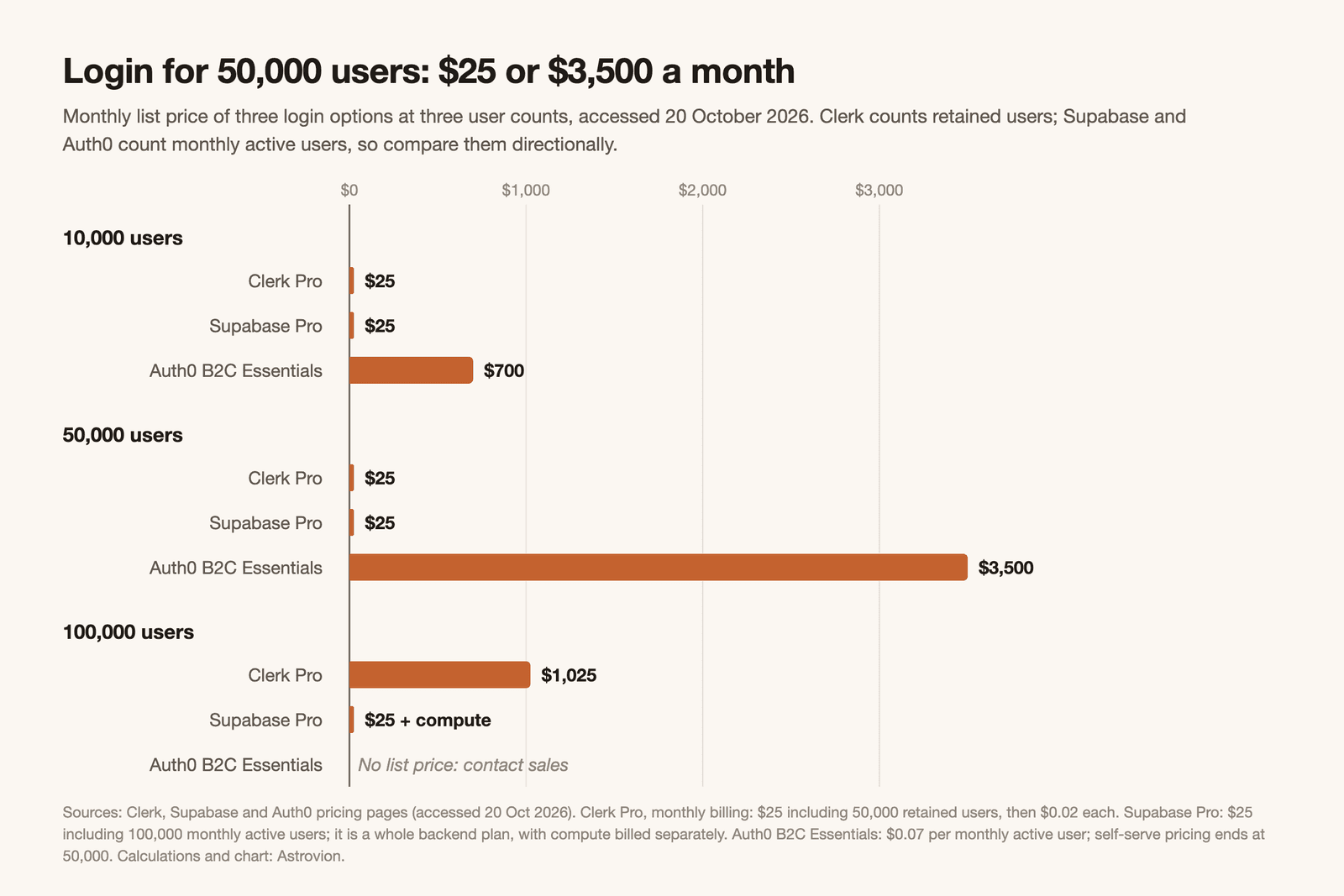
Clerk's Pro plan costs $25 a month and includes 50,000 retained users (Clerk counts users who come back at least a day after signing up). Supabase's Pro plan costs $25 and includes 100,000 monthly active users, but it is a whole backend plan, with database compute billed separately from $10 a month. Auth0's B2C Essentials plan works out to $0.07 per monthly active user: $700 a month at 10,000 users, $3,500 at 50,000, and above that its pricing page says to contact sales. The units differ, so treat the comparison as directional, but the gap is too wide to be a rounding question. A login provider chosen in week two of the build can be the biggest line on the running bill in year two.
Hosting and email are small at the start. Vercel's Pro plan is $20 a month per developer seat plus metered usage; Resend sends 50,000 emails for $20 a month. Orbix Studio says a pre-launch MVP often runs under $100 a month (no origin given).
Agencies disagree on running costs by more than ten times
Kolonell puts infrastructure at €200–€800 a month. RaftLabs says total running costs are $2,000–$8,000 a month, "not per year," and calls lower figures in other guides wrong. Netguru gives $10,000–$20,000 a month for support and maintenance, and on the same page says to budget about 20% of the development cost per year, which on its own mid-tier prices is roughly ten times less. Part of the gap is definition: infrastructure alone, or infrastructure plus maintenance hours and tools. None of the four says where its figure comes from. Once you have revenue, the operator surveys below are a better anchor.
What companies that run a SaaS actually spend
Two surveys of operating SaaS companies answer the question the cost guides skip. Neither publisher sells development.
SaaS Capital, a lender to SaaS companies, surveyed more than 1,000 private B2B SaaS companies in early 2026. Respondents reported what share of revenue goes to each department. The medians: R&D 22%, customer support and success 9%, hosting 5%, DevOps 4%. Hosting stays near 5% from under $1 million of revenue up to $20 million. R&D depends on funding: bootstrapped companies spend a median 16%, equity-backed ones 25%. The figures are self-reported, and the medians can't be added into a typical budget, because each one comes from a different mix of companies.
Aleph, a finance-software vendor, with the benchmarking firm Benchmarkit, analysed 2025 results from 342 SaaS and AI-native companies. Median R&D was 27% of revenue, and 32% for companies under $5 million. Their software gross margin under $5 million was 72%: about 28 cents of every revenue dollar goes to delivering the product (hosting, support, third-party services, AI usage) before anyone builds anything new.
Two surveys, two R&D numbers
SaaS Capital's 22% is a share of recurring revenue from a survey early in 2026; Aleph and Benchmarkit's 27% is a share of total revenue from 2025 results. For companies under a few million in revenue, the gap widens: about 22% in SaaS Capital's $1–3 million band, 32% in Aleph's under-$5 million band. We show both, not an average.
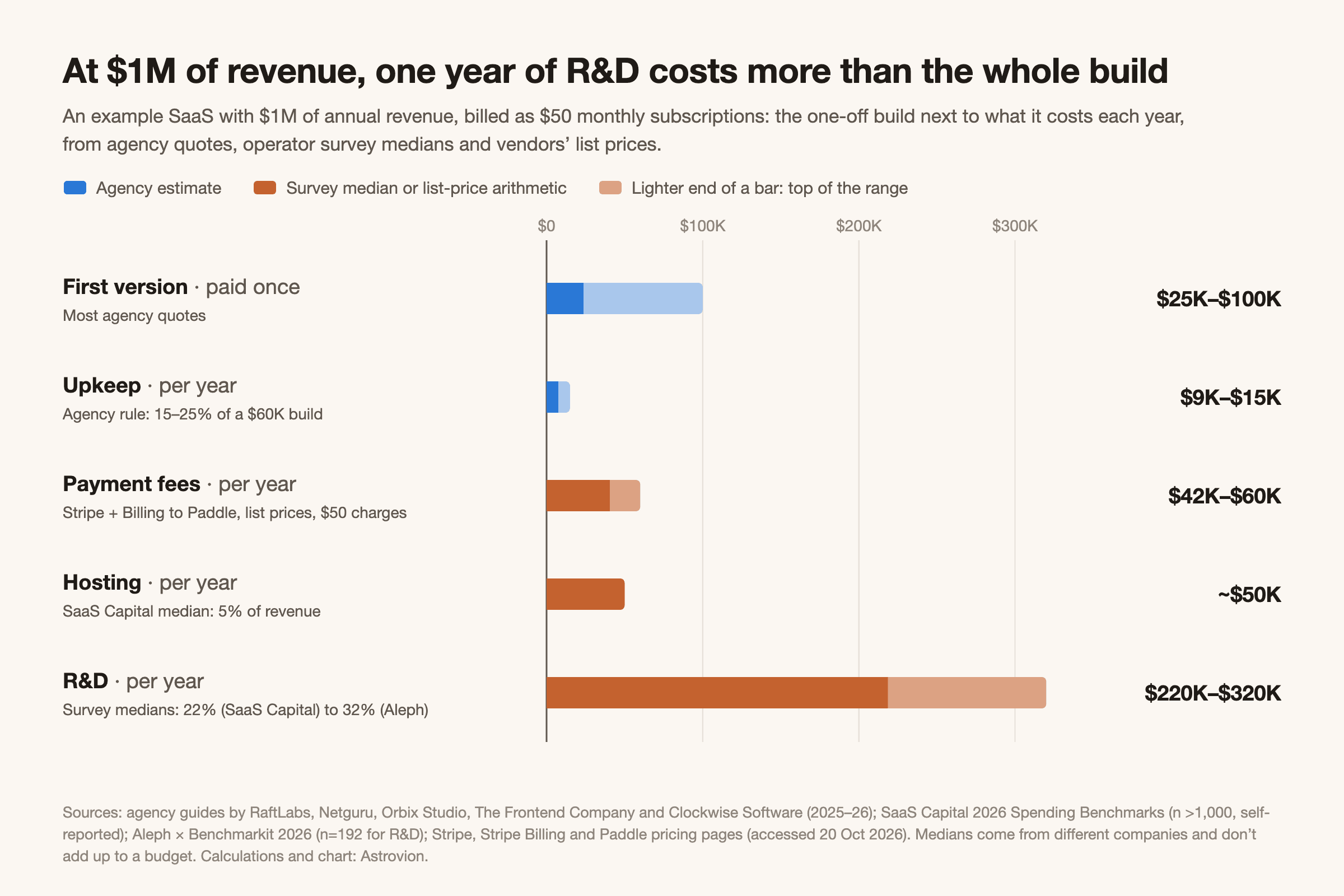
Put a $1 million SaaS next to its own build quote and the order flips. The first version was, say, $25,000–$100,000, once. The agency upkeep rule says $9,000–$15,000 a year. The operators' medians say $220,000–$320,000 a year in R&D, about $50,000 in hosting, and $42,000–$60,000 in payment fees. R&D is not the same as maintenance: it pays for the features that keep customers renewing. But a SaaS with paying customers keeps building, and those budgets show how much.
What moves your build number
Once you've decided what the first version must do, five things set the price.
| Driver | Pushes it up | Pushes it down | Evidence |
|---|---|---|---|
| Who builds it, and where | US agencies at $150–$250/hr (RaftLabs' figure) | India-based teams at $15–$25/hr (same source) | Contested; see below |
| Tenancy model | separate per customer, per-customer settings, SSO | shared database, one configuration | Clockwise: costly to change after launch; no source prices the depths |
| Billing model | usage-based, multi-currency, proration, tax | one flat monthly plan | Clockwise; RaftLabs prices multi-currency at $3K–$7K |
| Compliance | SOC 2, HIPAA | none required yet | Atlant: $42K median for a first SOC 2 Type 1 |
| AI features | +$10K–$40K and up (RaftLabs), +$10K–$50K and up (Orbix Studio) | none in version one | agency estimates only |
Hourly rates are the most contested input. RaftLabs puts US agencies at $150–$250 an hour and DesignRevision puts US and Canadian seniors at $120–$200 or more. Clutch's pricing page lists the US at $50–$99, below Canada and Australia at $100–$149. Clutch's figures look like the rate brackets agencies choose for their own profiles, not invoiced rates, and the page doesn't say. If a quote leans on a rate benchmark, ask whose it is.
Where the money goes inside a build is less contested. Clockwise Software gives an illustrative split of 55–60% development, 5–10% discovery, about 10% design, and 20–25% for QA, project management and DevOps. Orbix Studio's split of a $100,000 build is close: 50% for frontend and backend together, 10% each for discovery and design, 20% for QA and DevOps, and a 10% contingency line. Both are agency estimates.
The trap: a quote that ends at launch
The usual failure isn't a bad build price. It's a budget that ends the day the product goes live, with the running bill, the second-year development and the overrun reserve all missing.
Budget for the tail, not the average
Bent Flyvbjerg and Alexander Budzier of Oxford's Saïd Business School compared budgets with actual costs for 1,471 IT projects. The average overrun was a manageable 27%. But one project in six overran by an average of 200% on cost and almost 70% on schedule. The sample is large, mostly US public-sector systems averaging $167 million, and the study is from 2011, so don't read 27% or 200% as SaaS MVP rates. What carries over is the shape: most projects overrun a little, and a meaningful minority overrun a lot. A budget planned to the average has no room for the minority. The Frontend Company builds a 15–30% contingency into its own formula; that covers the average, not the tail.
The running-cost choices hide the same way. A login provider or a payments setup is picked during the build, often by whoever is writing that part of the code, and it decides a cost that grows with every user and every dollar. Auth0, Clerk and Paddle all advertise ways to export your data and leave, but no source we read prices a migration once you have customers on it.
Bottom line
A first SaaS version costs $25,000–$100,000 at most agencies, and anywhere from $5,000 to $150,000 at the extremes. Budget it as the smaller number. Once the product has revenue, R&D runs at a median 22–27% of revenue, hosting around 5%, and payment fees 4–6%, every year.
Three things to do before you sign:
-
Get the SaaS line items quoted separately, and defined. Multi-tenancy (shared or separate, which per-customer settings), billing (trials, upgrades, proration, failed-payment retries, tax), roles and the admin panel. Prices for these vary more than ten times between guides, so a single number for "the platform" hides the decisions.
-
Price the vendors before the build. Run your expected users and revenue through the list prices of the login and payment options you are choosing between. At 50,000 users, login costs $25 or $3,500 a month depending on the provider; on $1 million of revenue, payments cost $42,000 or $60,000 a year depending on whether someone else files your sales tax.
-
Budget year two as a share of revenue, and keep a reserve for the tail. The 15–25% maintenance rule covers keeping the lights on, not building what customers ask for next. Take the operator medians as a starting point, and hold back a contingency sized for the projects that overrun badly, not the average one.
Planning a SaaS and want both numbers before you commit? We start with a paid scoping sprint: you walk away with a build estimate split by line item, with multi-tenancy, billing and roles defined, and a running-cost model at your own user and revenue forecasts for the login, payment and hosting options you're weighing. It's yours to keep, whoever ends up building the product. Request a consultation →

Sources
Operator benchmarks and research:
- Nick Perry, SaaS Capital — 2026 Spending Benchmarks for Private B2B SaaS Companies (Jun 2026)
- Aleph and Benchmarkit — 2026 SaaS & AI Performance Benchmarks: gross margin and R&D as a share of revenue (2026)
- Hannah Hicklen, Clutch — Software Development Company Pricing Guide (Sep 2026)
- Bent Flyvbjerg and Alexander Budzier — Why Your IT Project May Be Riskier Than You Think, Harvard Business Review (Sep 2011)
- Alexander Sverdlov, Atlant Security — SOC 2 Type 1 in 2026: What 14 Real Engagements Cost (May 2026)
Vendor pricing pages (list prices, accessed 20 October 2026):
Agency cost guides:
- Illia Demidov and Bogdan Yemets, Clockwise Software — How Much Does It Cost to Build a SaaS Platform? (Aug 2026)
- Riya Thambiraj, RaftLabs — How Much Does It Cost for SaaS Application Development in 2026 (Oct 2025)
- Alex Vasylenko, The Frontend Company — SaaS Development Costs: Estimates, Stages, and How to Save Money (Sep 2025)
- Kacper Rafalski, Netguru — SaaS Development Costs: A Comprehensive Breakdown (updated Jul 2026)
- Shohanur Rahman, Orbix Studio — SaaS Development Costs in 2026 (Aug 2026)
- Mohamed Bah, Kolonell — B2B SaaS MVP Budget in Berlin (Sep 2026)
- DesignRevision — How Much Does It Cost to Build a SaaS? (Feb 2026)
All figures are quoted from these publications for commentary and analysis; the tables, comparisons, worked examples and conclusions in this article are our own. Every image and chart was made for this article.