
1 min readOleksii Buhaiov
Does AI Make Software Development Cheaper in 2026? What the Measured Data Shows
What the research says about AI and the cost of building software in 2026 — why a 56% faster coding task becomes a 15–25% cheaper project at best, where the saving leaks into review and rework, and three questions to ask before you accept an "AI discount" on a quote.
- ai-software-development
- development-cost
- ai-coding-tools
- code-quality
- research
On this page

In 2022, researchers from GitHub and Microsoft gave 95 freelance developers one job: write an HTTP server in JavaScript. Half of them had GitHub Copilot. The Copilot group finished in an average of 71 minutes; the group without it took 161. That is the origin of the "55% faster" you still see in sales decks.
In 2025, the AI research non-profit METR gave sixteen experienced open-source developers real issues from their own repositories, randomly allowing or banning AI tools for each one. With AI, they took 19% longer.
Meanwhile, one agency blog tells you AI has cut its coding time "by around 50 percent", and another, writing three weeks later, says the real saving on a project is "more like 10-25%".
These numbers don't cancel out. They were measured at different levels: one task, one developer, one team, one project. When someone tells you AI makes your build cheaper, the first question is: measured at what level? The further out you look, the smaller the saving gets.
Where these numbers come from
We built this article from 17 published sources: three randomised trials and a follow-up, field experiments inside three companies, two reports from Google's DORA delivery research, three developer surveys, three telemetry studies, a security benchmark, and three agency cost guides. Almost all of them come from organisations with a stake in the answer: two of the three trials were run by the companies that make the tools, and the quality studies by companies that sell code-analysis products. We name the publisher every time a number appears. Full list at the end.
The honest headline answer
AI makes writing code faster in most measured settings. It makes a software project cheaper by much less. The best estimate we have puts the saving at 15–25% of total cost, and that estimate is one agency's arithmetic, not a measurement.
None of the sources we read measured the full cost of building the same product with and without AI. Every project-level figure is an estimate, and the people making it sell builds.
| Claim | Who makes it | What it actually measured |
|---|---|---|
| "around 50 percent" less coding time | Upstack Studio, a small app agency (now closed) | Its own coding hours, by its own estimate; the title stretches it to total cost |
| 30–50% saving on simple MVPs, 5–10% on complex or compliance-heavy builds | IndianAppDevelopers, an India-based agency's MVP cost guide | Not stated |
| 10–25% of total project cost, "realistic" 15–25% | Chop Dawg, a US app agency | Its own arithmetic, explained below |
So the range you'll be quoted runs from a few percent to half. The research below explains why the low end is the safer bet for anything more complex than a standard CRUD app (screens that create, read, update and delete records).
The zoom-out ladder: the same tools, measured at seven levels
Here is the comparison we could not find anywhere else: the main studies of AI coding tools, ordered from the smallest frame (one task in a lab) to the largest (a whole company). The grouping and order are ours.
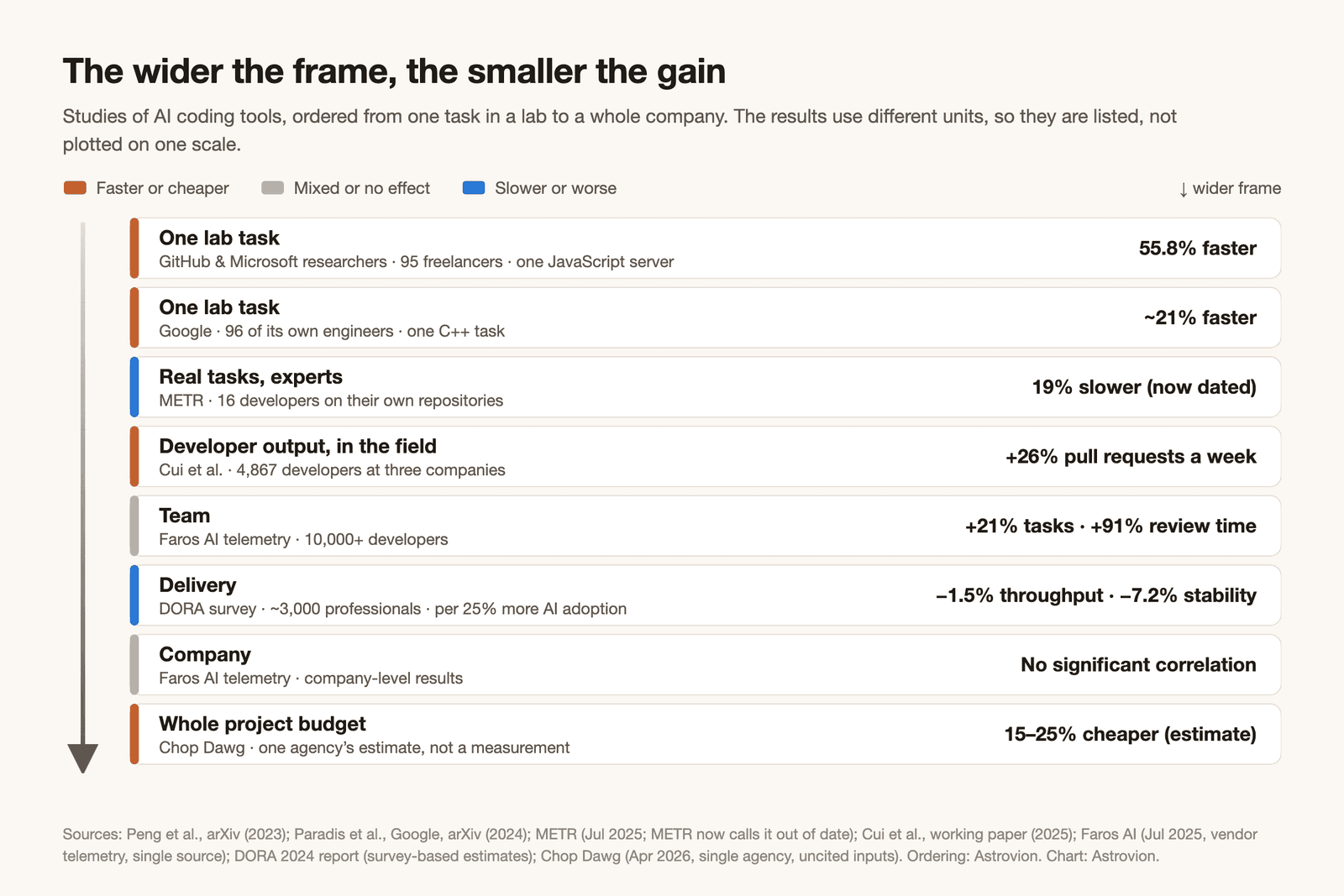
| Level | Study | Result | What it can't tell you |
|---|---|---|---|
| One lab task | GitHub and Microsoft researchers, 95 freelancers, one JavaScript server | 55.8% faster (71 vs 161 minutes) | Anything about code quality, which wasn't measured |
| One lab task | Google, 96 of its own engineers, one C++ task | About 21% faster (96 vs 114 minutes) | Whether it holds beyond a task of under three hours; the adjusted estimate isn't statistically significant |
| Real tasks, experts | METR, 16 developers on their own repositories | 19% slower, while feeling 20% faster | Current tools; METR now calls it out of date |
| Developer output, in the field | Cui et al., 4,867 developers at Microsoft, Accenture and a Fortune 100 firm | +26% completed pull requests a week | Whether more pull requests meant more finished product |
| Team | Faros AI telemetry, 10,000+ developers | +21% tasks completed, but +91% pull request review time | Causation: it's a correlation |
| Delivery | DORA (Google Cloud), survey of ~3,000 professionals | Per 25% rise in AI adoption: throughput −1.5%, stability −7.2% | Direct measurement: these are survey-based estimates |
| Company | Faros AI telemetry | No significant correlation between AI adoption and company-level results | Why, beyond the review bottleneck |
The pattern is the same one we found when we looked at AI and personal productivity: the wider the frame, the smaller the gain, and at the widest frames it can turn negative.
Three things are worth knowing about the top of the ladder. First, both big speed-ups come from vendors testing their own products: the 55.8% from GitHub and Microsoft researchers, the 21% from nine Google employees evaluating Google's internal tools. The Google team says plainly that it cannot "fully eliminate the risk associated with us evaluating our own team's developer tools." Second, both were single, self-contained tasks, the kind of work AI is best at. Third, neither measured quality. The Copilot paper says so directly: "this study does not examine the effects of AI on code quality."
The field experiments are the most useful middle rung. Kevin Zheyuan Cui, Mert Demirer, Sonia Jaffe, Leon Musolff, Sida Peng and Tobias Salz pooled three randomised rollouts of Copilot and found a 26.08% increase in completed pull requests per week (standard error 10.3%). Two of the authors work at Microsoft, which sells Copilot. The authors themselves note that this is "substantially smaller" than the lab result, and they give the reason in one line: "coding is only part of a software developer's job."
At the bottom, METR's trial is the only one in this set run by an organisation with nothing to sell. METR has since said its result is out of date, and its larger 2026 re-run could not produce a figure it trusts, partly because 30–50% of developers said they were choosing not to submit some tasks to the study. So nobody should quote −19% as current. What still holds is that experts felt faster while the clock said slower.
The arithmetic: why a faster step doesn't make a cheaper project
Engineers call this Amdahl's law: speeding up one part of a process speeds up the whole only in proportion to that part's share. If coding is half the project and AI halves the coding, the project gets a quarter cheaper, not half.
Two agency sources put the coding share of a build at roughly half. IndianAppDevelopers' MVP guide gives development 40–50% of the budget, with discovery, design, QA and deployment taking the rest. Chop Dawg says "code writing is only 40-55% of the total development budget." Both are agencies, but they reached the number separately and they agree.
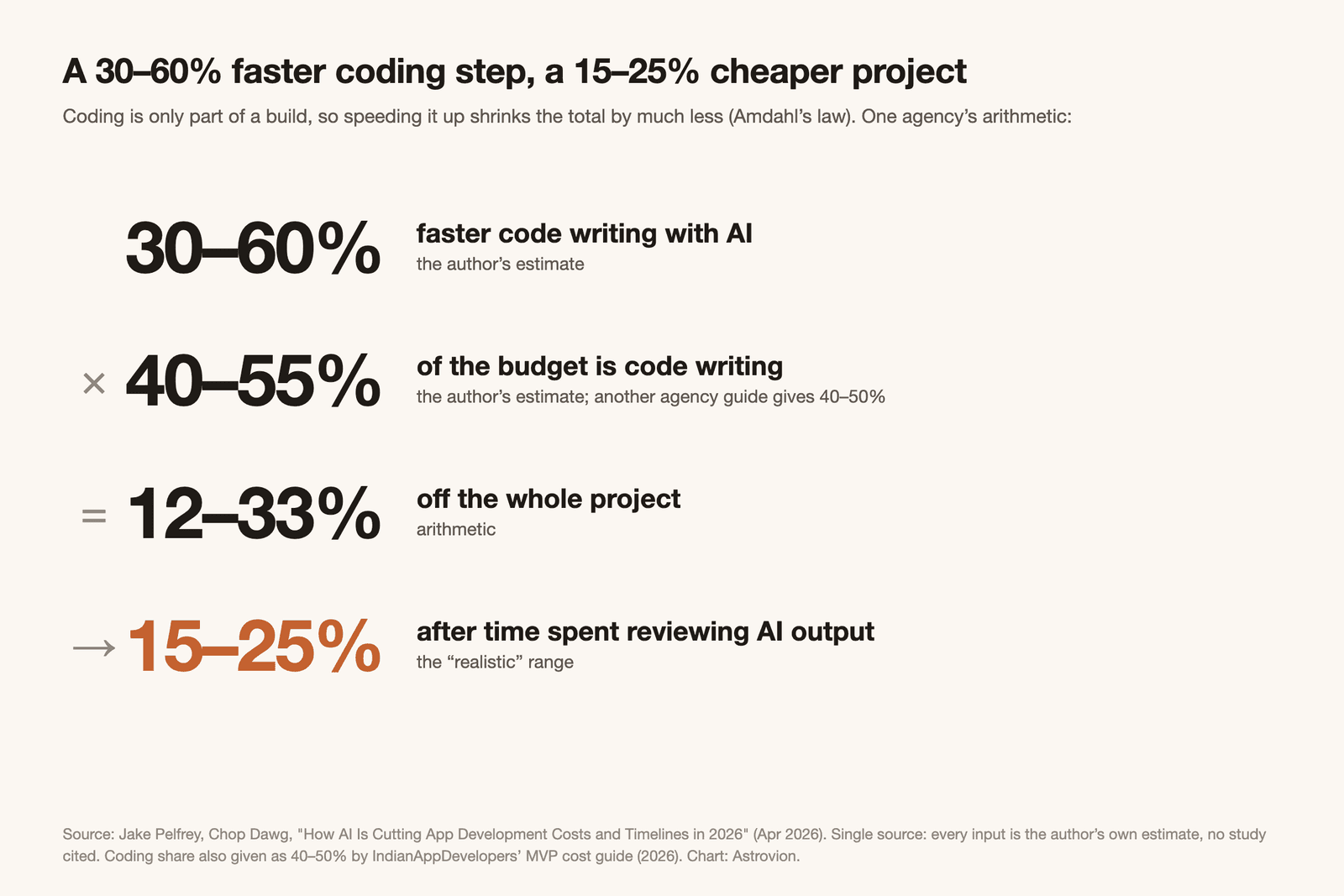
Chop Dawg's full calculation: AI saves 30–60% of code-writing time; code writing is 40–55% of the budget; so the whole project saves 12–33%, and after the time spent reviewing AI output, a "realistic" 15–25%.
Single source — unverified
The 15–25% project saving traces to one blog post by Jake Pelfrey at Chop Dawg, a US app agency (April 2026). Every input in it, the 30–60% coding speed-up and the 40–55% coding share, is the author's own estimate with no study cited. The agency's own price history shows costs falling 33–63% since 2020–23, and the author attributes only about 10–20% of that to AI. No study we found measures project cost with and without AI. Treat it as a well-reasoned estimate, not a benchmark.
From the developer's side of the desk, the share is smaller still. Atlassian's 2025 developer-experience survey of 3,500 people, citing an IDC study, puts coding at 16% of a developer's working week. Most AI tools target that 16%. In the same survey, 68% said AI saves them more than 10 hours a week, and half said they lose more than 10 hours a week to organisational friction. Atlassian's own summary is that "we're right back where we started." That is a vendor-commissioned, self-reported survey, and half of its 3,500 respondents are managers, but it describes the same shape as the ladder.
What moves your number
Whether your build lands near 5% or near 25% depends on four things. None of them is which AI tool the agency uses.
| Driver | Pushes the saving up | Pushes it down | Evidence |
|---|---|---|---|
| How much of the build is routine code | CRUD screens, standard integrations, tests, documentation | New algorithms, unusual UX, architecture, security-critical code | Agency estimates only (Chop Dawg: CRUD apps 20–30%, little or nothing on novel work) |
| How complex and regulated the product is | Simple MVP | Compliance-heavy build | Agency guide: 30–50% simple vs 5–10% complex |
| Who is doing the work | Developers newer to the stack or codebase (contested) | Experts in a mature codebase they know well | Microsoft field data vs Google RCT vs METR (below) |
| Review capacity | Reviewers who can keep up with more, larger pull requests | Review becomes the queue everything waits in | Faros: review time +91%, pull request size +154% |
The experience question is genuinely open. In the Microsoft field experiment, junior developers increased output by 21–40% and seniors by 7–16%, but the difference wasn't statistically significant. Google's trial found the opposite tendency on its complex C++ task, also not significant, and concluded that "AI is not yet able to close a skill gap when applied to complex tasks." METR's slowed-down developers were experts on their own code. If an agency tells you its senior team gets the biggest AI gains, or the smallest, no study settles it either way.
Review capacity is the one to watch. Faros AI's telemetry found that on high-adoption teams developers completed 21% more tasks and merged 98% more pull requests, while review time rose 91% (single source: Faros AI, a vendor of engineering analytics, July 2025 — correlational, from its own customer data). In Sonar's survey of 1,149 developers who use AI, 38% said reviewing AI-generated code takes more effort than reviewing a colleague's. When code gets cheaper to write, reviewing it becomes the slow step.
The trap: the saving moves, it doesn't vanish
The usual failure is a quote that takes the coding speed-up off the whole price and leaves review and QA at their old size, or cuts them. The saving looks real on paper. Then it comes back as rework, bugs and a slower second year.
Every source on this was published by a company that sells a tool to fix the problem, so read each number as a signal, not a precise size. But they come from different companies using different methods, and they all point the same way.
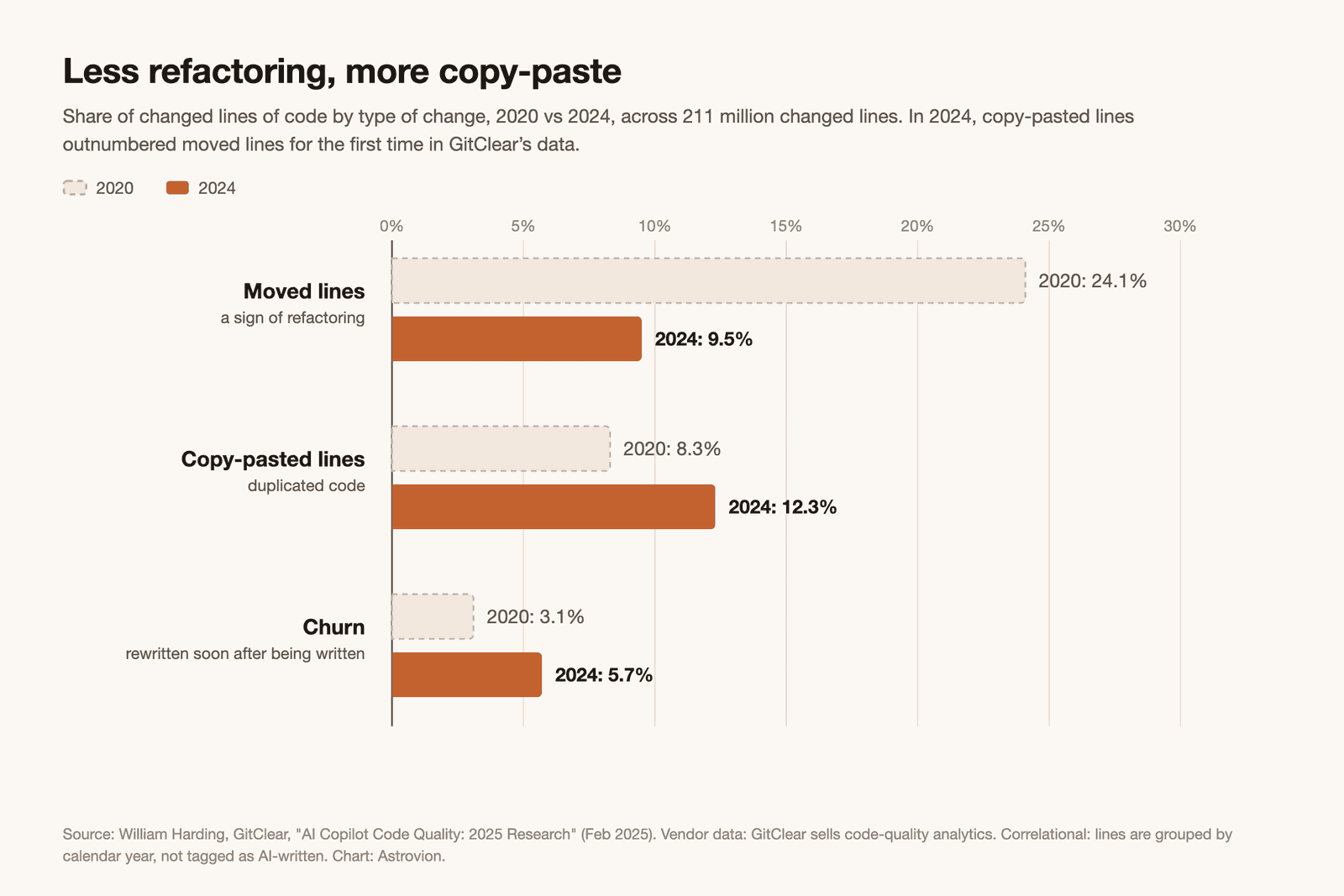
- Less refactoring, more copying. GitClear analysed 211 million changed lines of code from 2020 to 2024. The share of lines moved (a sign of refactoring, which means restructuring existing code without changing what it does) fell from 24.1% to 9.5%. Copy-pasted lines rose from 8.3% to 12.3%. Churn, meaning code rewritten soon after it was written, rose from 3.1% to 5.7%. In 2024, copy-pasted lines outnumbered moved lines for the first time in GitClear's data. The link to AI is by calendar year, not by tagging AI-written lines.
- More bugs. Uplevel compared 785 developers with and without Copilot access and found a 41% higher bug rate with no significant change in efficiency. The study is observational, and Uplevel doesn't define its bug rate. Faros AI found 9% more bugs per developer.
- Security flaws on risky tasks. Veracode tested more than 100 language models on 80 coding tasks chosen because they invite security mistakes. In 45% of cases, the model introduced a vulnerability from the OWASP Top 10 (the standard list of the most critical web-application security risks); for Java it was 72%, and newer, larger models did no better. That is 45% of risky tasks, not 45% of all AI code.
- Less stable delivery. DORA's 2024 report estimated a 7.2% drop in delivery stability for every 25% rise in AI adoption. Its 2025 report found throughput now improving with AI, but AI adoption "still increases delivery instability."
- Developers don't trust it, and many don't check. In Sonar's 2026 survey, 96% of developers said they don't fully trust that AI-generated code is functionally correct, yet only 48% said they always check it before committing. In Stack Overflow's 2025 survey, the top frustration, named by 66%, was AI output that is "almost right, but not quite."
Two numbers to stop repeating
Two AI-code statistics circulate on agency cost pages and don't hold up. "Architectural flaws up 153%", attributed to Veracode in one MVP cost guide, does not appear in Veracode's published report material. "1.7x higher bug density" in another links to a McKinsey survey page that doesn't contain it. If a quote leans on either, ask for the original.
None of our sources measures how much AI-written code adds to maintenance after launch. The MVP guides we track already put maintenance at 15–33% of the original build cost per year, before any AI effect. A build that saved 20% on coding and paid for it in duplicated, under-reviewed code can lose that saving in the first year of upkeep. How often that happens hasn't been measured, and we won't put a number on it.
Bottom line
Expect AI to cut the coding part of your build, not the whole build. A 15–25% total saving is a reasonable ceiling for typical projects, and that ceiling is itself an estimate. Budget review and QA as if the code were written by a fast junior developer, because in effect it is.
Three questions to ask before you accept an "AI discount":
-
"Which hours does the discount come off?" Ask for the quote split by phase: discovery, design, development, QA, deployment. If the AI saving is applied to the whole price, ask why discovery and design got cheaper. AI speeds up writing code, and the measured studies say little about the rest.
-
"Where did the review time go?" More code, written faster, means more to review. The telemetry shows review time rising, not falling. If the QA and code-review lines shrank along with development, the saving is likely to come back as rework.
-
"What did you measure, and on what?" A vendor's lab task, a survey of how fast developers feel, or the agency's own past projects are three very different kinds of evidence. Ask what kind theirs is. Self-reports go wrong in both directions: METR's experts thought they were 20% faster and were 19% slower; the Copilot trial's participants underestimated their gain.
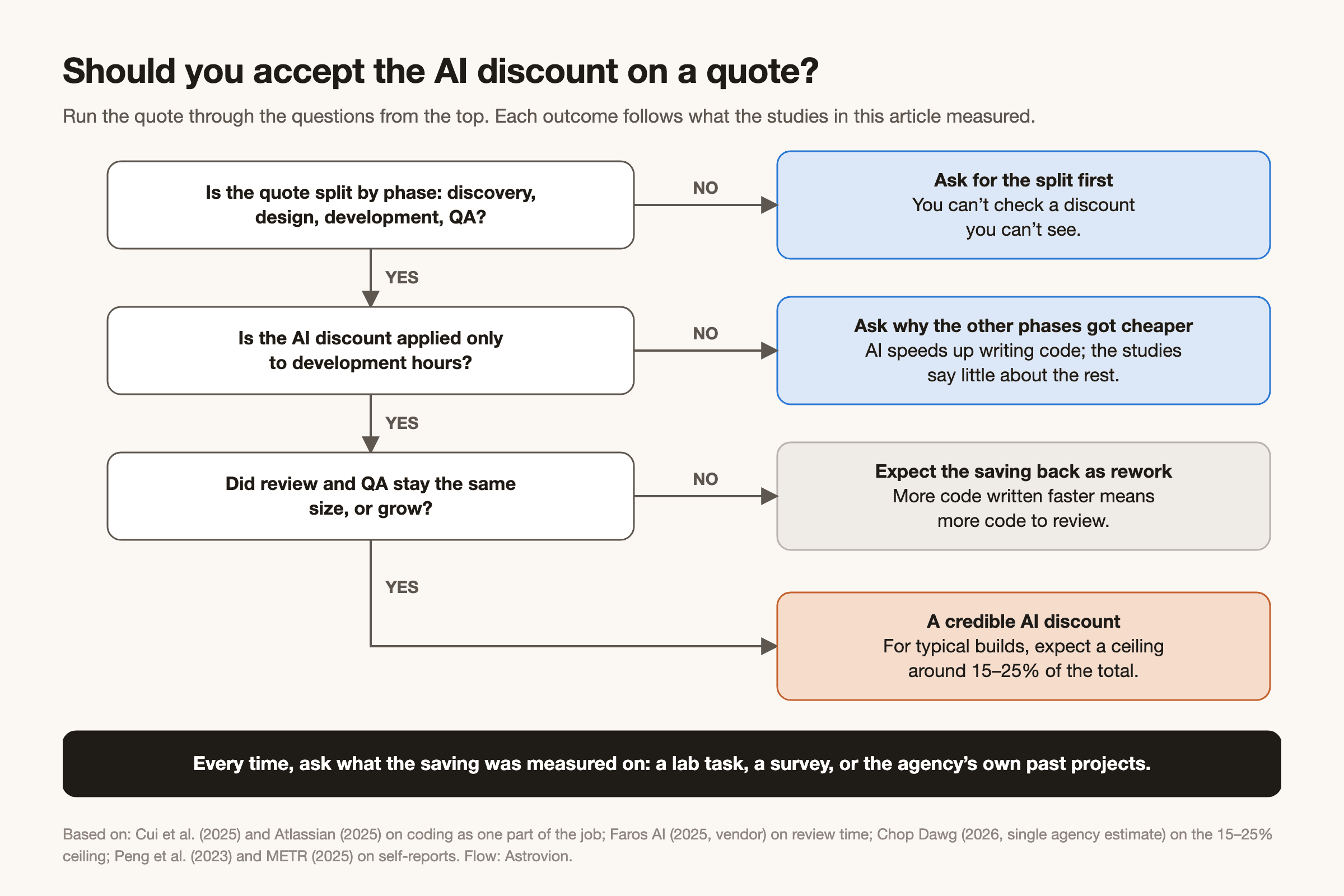
AI can make your build cheaper. The risk is a discount taken off the wrong lines of the quote, with the cost turning up a year later in maintenance.
Want to know what AI will actually save on your build before you sign a quote? We start with a paid scoping sprint: you walk away with a quote broken down by phase, the AI saving applied only to the work it measurably speeds up, and review and QA budgeted for the volume of code AI produces. It's yours to keep, whoever ends up building the product. Request a consultation →

Sources
Randomised and field experiments:
- Sida Peng, Eirini Kalliamvakou, Peter Cihon, Mert Demirer — The Impact of AI on Developer Productivity: Evidence from GitHub Copilot, arXiv (Feb 2023)
- Elise Paradis, Kate Grey, Quinn Madison, Daye Nam, Andrew Macvean, Vahid Meimand, Nan Zhang, Ben Ferrari-Church, Satish Chandra, Google — How Much Does AI Impact Development Speed? An Enterprise-Based Randomized Controlled Trial, arXiv (Oct 2024)
- Joel Becker, Nate Rush, Beth Barnes, David Rein, METR — Measuring the Impact of Early-2025 AI on Experienced Open-Source Developer Productivity (Jul 2025); and We Are Changing Our Developer Productivity Experiment Design (Feb 2026)
- Kevin Zheyuan Cui, Mert Demirer, Sonia Jaffe, Leon Musolff, Sida Peng, Tobias Salz — The Effects of Generative AI on High-Skilled Work: Evidence from Three Field Experiments with Software Developers, working paper (Feb 2025)
Delivery research and surveys:
- DORA, Google Cloud — 2024 Accelerate State of DevOps Report (Oct 2024) and 2025 State of AI-Assisted Software Development (Sep 2025)
- Stack Overflow — 2025 Developer Survey: AI (2025)
- Sonar — State of Code Developer Survey (Jan 2026)
- Atlassian with Wakefield Research — State of Developer Experience Report 2025 (Jul 2025)
Vendor telemetry and benchmarks:
- Faros AI — The AI Productivity Paradox (Jul 2025)
- William Harding, GitClear — AI Copilot Code Quality: 2025 Research (Feb 2025)
- Uplevel Data Labs — Can Generative AI Improve Developer Productivity? (Aug 2024)
- Veracode — 2025 GenAI Code Security Report (Jul 2025)
Agency cost guides:
- Jake Pelfrey, Chop Dawg — How AI Is Cutting App Development Costs and Timelines in 2026 (Apr 2026)
- Ashraf Farid, Upstack Studio — Developers Are Using AI to Cut Software Development Costs in Half (Mar 2026)
- Juned Ghanchi, IndianAppDevelopers — MVP Development Cost (2026)
All figures are quoted from these publications for commentary and analysis; the tables, comparisons and conclusions in this article are our own. Every image and chart was made for this article.